
Swarnagiri Temple and the Living Language of Devotion
On the Manepally Hills near Bhuvanagiri in Telangana, a contemporary temple carries forward an older vocabulary of faith and craftsmanship.
A wheel, a sacred mark, a conch. Carved into grey stone at Swarnagiri, these forms invite a closer look. Before a visitor has read a signboard or learned the names of the shrines, the sculpture has already begun to tell a story.
Swarnagiri Sree Venkateswara Swamy Devasthanam stands on the Manepally Hills near Bhuvanagiri, roughly 50 kilometres from Hyderabad. Dedicated to Lord Venkateswara, it offers a setting in which to explore how sacred imagery continues to shape Indian temple life. [1, 2]
For Bharatiyata, the interest lies in that continuity. A newly built temple can help us understand traditions that remain familiar to devotees while opening them to people encountering this visual language for the first time.
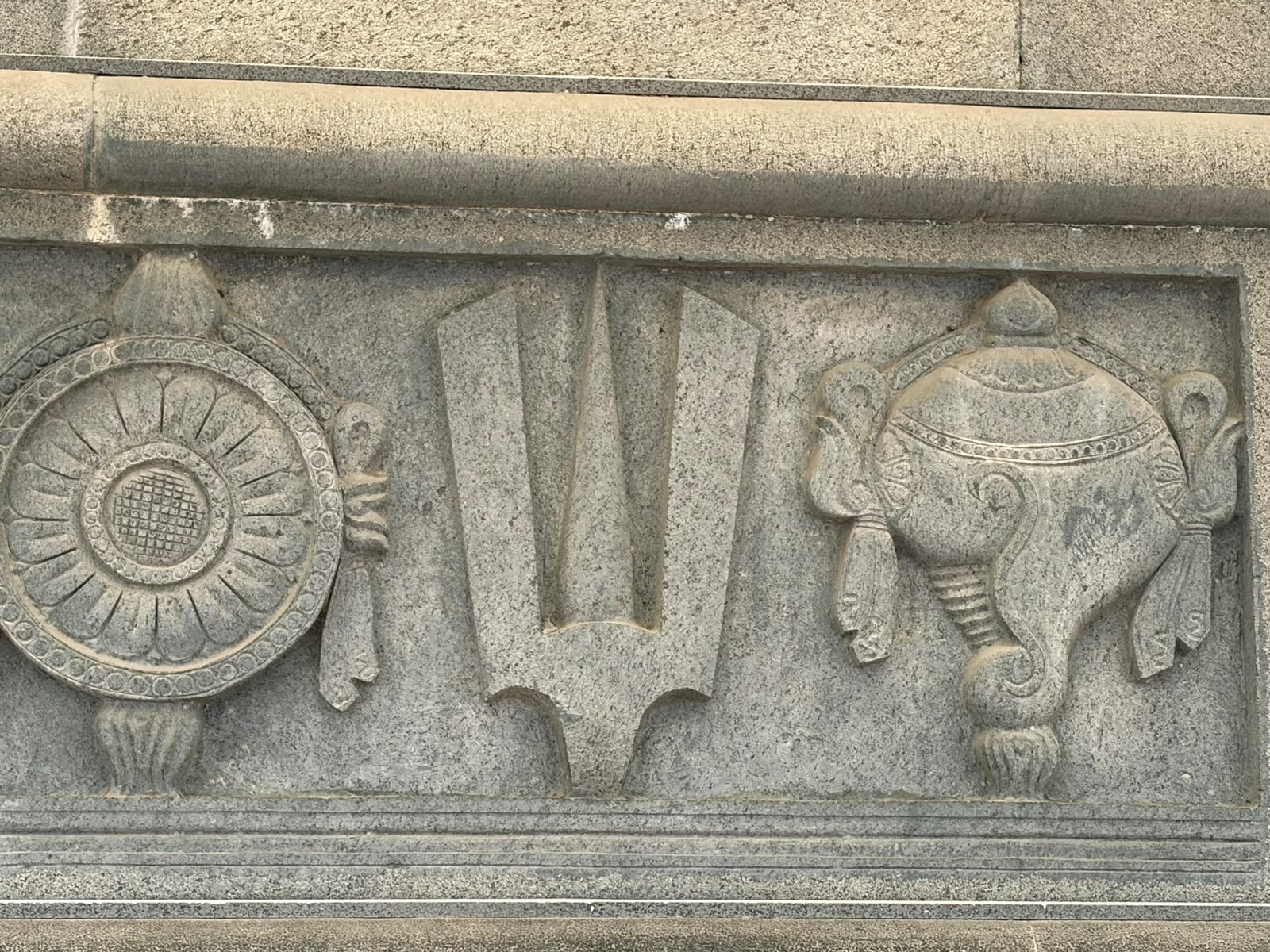
Chakra, Vaishnava sacred mark and shankha carved into stone at Swarnagiri. Photo: Bharatiyata Foundation.
A contemporary temple with older roots
Developed by the Manepally family and consecrated in March 2024, Swarnagiri belongs to the present chapter of temple building in Telangana. Its relationship with Sri Chinna Jeeyar Swamiji is documented in an account published by his organisation. [3]
That recent history is part of its significance. Sacred architecture remains an active practice, requiring patrons, designers, craftspeople and people who sustain worship after construction ends. Swarnagiri gives visitors an opportunity to see this practice taking shape in their own time.
Reading the symbols in stone
The carved panel brings together the chakra, or discus, the shankha, or conch, and a Vaishnava sacred mark. The discus and conch are established attributes of Vishnu, recognisable across many periods of Indian art. [4] Together, these signs help locate the temple within the devotional world of Vishnu and Venkateswara.
Look closely at the carving itself. The wheel is articulated through repeating spokes and layered rings; the conch has a rounded body and decorative bands. The sculptor has given each form enough detail to be distinctive, while keeping the composition clear. Even a small panel can reward patient attention.
Garuda and the posture of devotion
Among Swarnagiri’s striking figures is Garuda, his wings rising beside his body and his palms joined in reverence. Bright yellow and green cloth wraps the dark sculpture, bringing colour to its carefully modelled form.
Garuda is Vishnu’s vahana, or divine mount. [5] Here, the joined hands draw attention to devotion as well as strength. For a visitor unfamiliar with the figure, the posture offers an immediate point of entry: a powerful presence shown in an act of reverence.
It is a reminder that sculpture communicates through the body. The hands and wings help us read the figure before we know the stories associated with him.
Jala Narayana and the presence of water
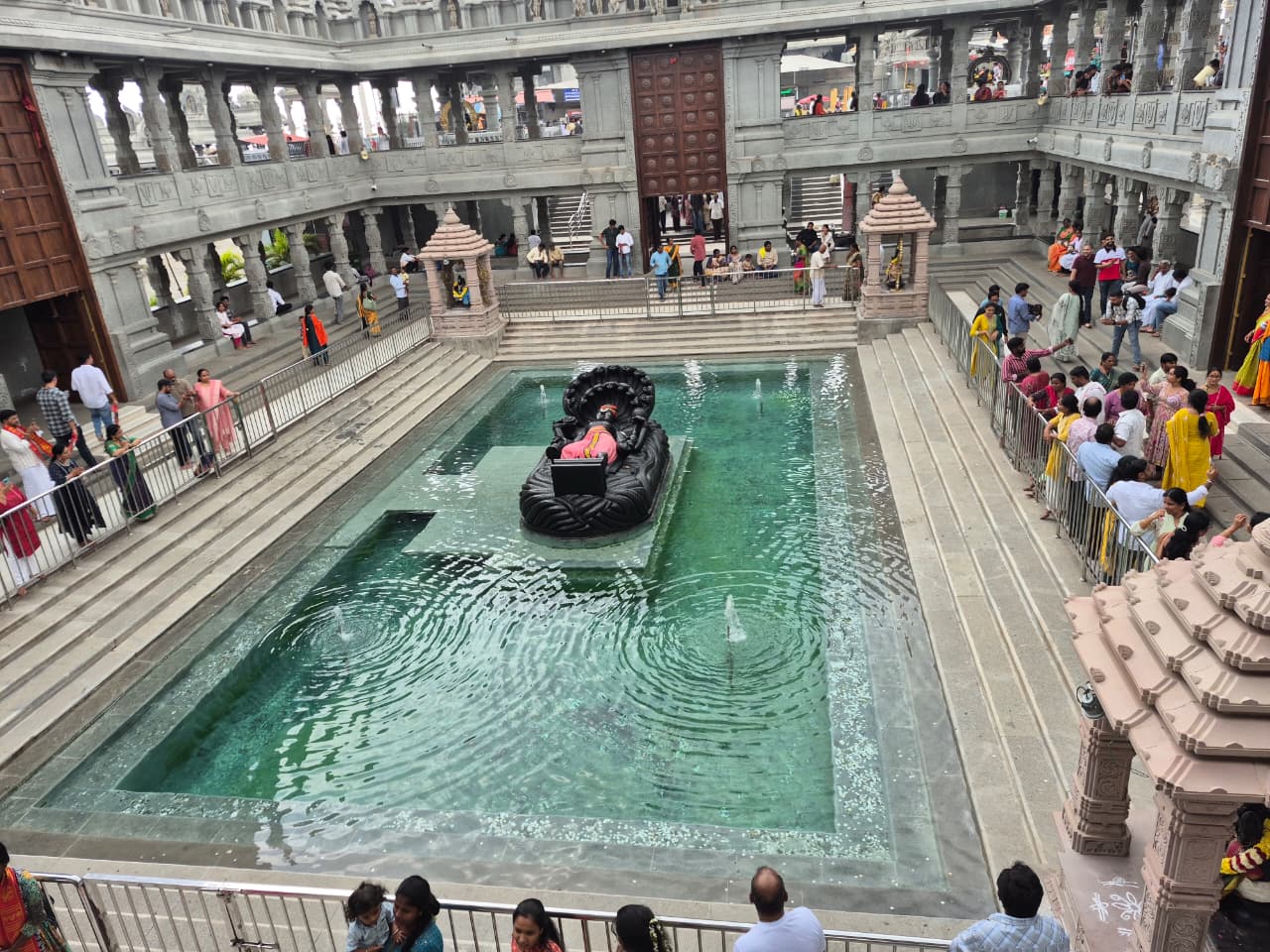
At Swarnagiri’s Jala Narayana shrine, Narayana reclines on serpent coils beneath a many-headed canopy. The shrine is named in accounts of the temple. [2, 3] The surrounding pool, stepped edges and carved galleries make the image the courtyard’s visual centre.
The Jala Narayana pool within its courtyard of carved pillars, galleries and small shrines. Photo: Bharatiyata Foundation.
Vishnu reclining on Shesha
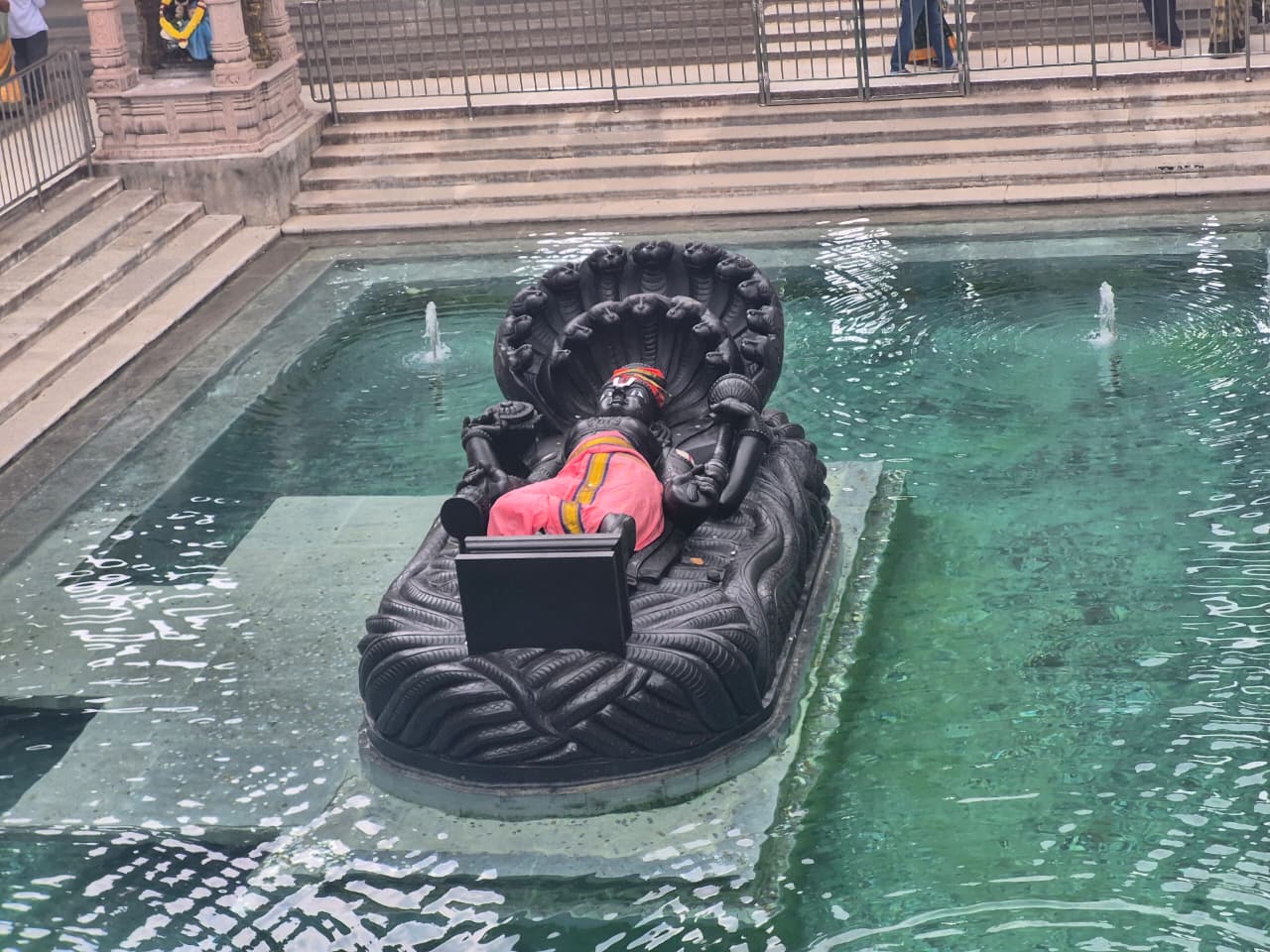
Narayana reclining on serpent coils beneath a many-headed canopy. Photo: Bharatiyata Foundation.
The pose belongs to the tradition of Vishnu reclining on Shesha, also called Ananta. In this imagery, the serpent’s coils support the god while its raised hoods form a shelter above his head. LACMA’s interpretation of a historical example explains Ananta as eternity and identifies the setting with the primordial ocean of milk. [6] The names and forms connect the sculpture with a much wider history of Vaishnava art.
The reclining posture is often associated with cosmic repose. The Michael C. Carlos Museum describes Vishnu resting between the dissolution and renewal of the universe. [7] Read through that tradition, the water at Swarnagiri can evoke a cosmic ocean. This is an interpretation of the imagery, rather than a claim that every feature of the courtyard has a documented symbolic meaning.
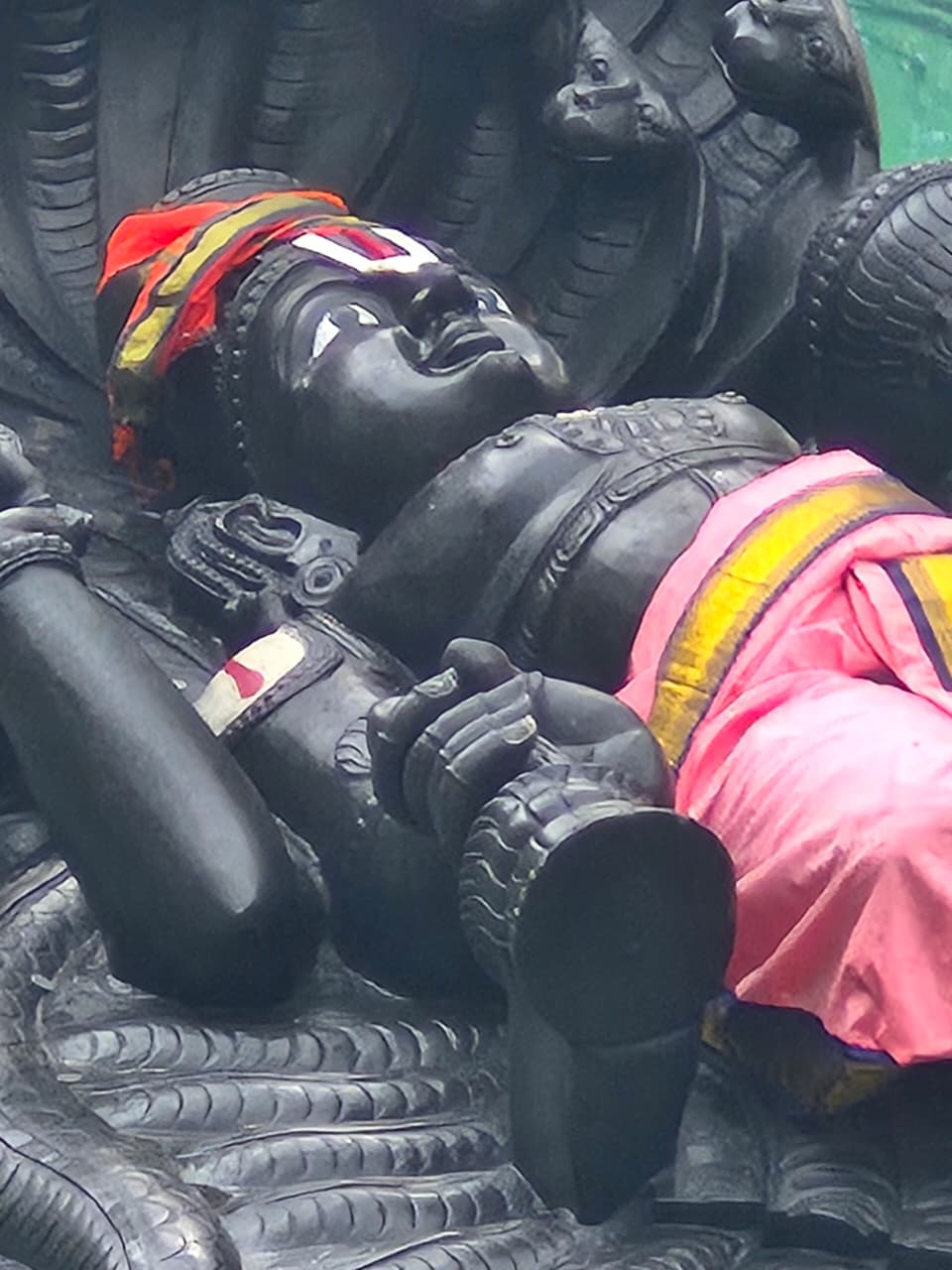
The face, jewellery and serpent canopy of the reclining figure. Photo: Bharatiyata Foundation.
The close-up also rewards attention to the sculptor’s work: the curving serpent bodies, the raised ornament on the chest and the carefully shaped features. Pink cloth and the painted forehead mark bring colour to the dark surface. From a distance, the pool establishes the setting; nearby, individual details make the figure easier to read.
The people behind the carving
Elsewhere in the complex, sculpted arches frame divine figures and a reddish pavilion displays rows of small columns, decorative bands and animal forms. Each element asks the maker to balance proportion with detail.
A 2024 report in Telangana Today names DNV Prasad Sthapathi as supervising the temple’s construction and describes artisans from different states contributing to the complex. [2] Their work deserves a place in the story alongside the patrons and sacred images.
A temple visit can become an introduction to craftsmanship. Looking at how a wing is shaped or how a border repeats encourages us to notice the skill that makes devotional imagery legible.
Planning a respectful visit
Swarnagiri is located on the Manepally Hills in Bhuvanagiri, Telangana. Visitors travelling from Hyderabad should allow for traffic and time spent at the temple, rather than treating the journey as a fixed-duration outing.
Before travelling, check the temple’s current darshan arrangements, seva bookings and dress requirements through its website or administration. Published schedules vary between pages, and ritual breaks can affect access. Follow the prescribed dress code, use designated footwear counters and observe restrictions on phones and photography. [1]
Ask staff about access arrangements if anyone in your group needs assistance. Where photography is permitted, keep pathways clear and give worshippers space. A photograph should never take priority over another person’s darshan.
Looking closely at living heritage
At Swarnagiri, the carved conch, Garuda’s joined hands and the water around Narayana offer starting points for understanding a living devotional tradition. Each invites a different question about the image, its meaning or the person who made it.
This is the kind of attention Bharatiyata hopes to encourage. We can learn to recognise a sacred symbol, acknowledge a craftsperson’s work and respect the practice that gives the place its purpose. On a visit to Swarnagiri, begin with one detail. Look carefully, ask about it, and let that understanding guide what you notice next.
Sources and further reading
[1] Swarnagiri Devasthanam. Temple location and visitor guidance.
[2] Sowmya Sangam, Telangana Today. Swarnagiri temple, an architectural marvel just about 50 km from Hyderabad. 2 April 2024.
[3] Chinna Jeeyar organisation. Swarnagiri’s Gold. Account of the July 2024 event.
[4] The Metropolitan Museum of Art. Vishnu, India Punjab, 10th–11th century.
[5] The Metropolitan Museum of Art. Vishnu Riding on Garuda, Nepal, dated 1004.
[6] Los Angeles County Museum of Art. Vishnu in His Cosmic Sleep, 13th century. Curatorial notes on Ananta, Shesha and the primordial ocean.
[7] Michael C. Carlos Museum, Emory University. Vishnu Sleeping on the Cosmic Ocean. Collection interpretation of cosmic rest and renewal.
Sources & corrections
Send a correction or a source we should read.
Revision history
- v0.1.0 · 2026-10-10T11:30:00.000Z — Recovered the original co-founder draft shared on 5 October 2026. Original wording and citation markers retained; section headings formatted for Markdown. Pending editorial review: photographs and rights, bibliography for [1]–[5], specific sourced consecration role, stronger maker reporting, and prose revisions. Article Date records the original draft date; confirm publication date and author display name before release. Not approved for publication.
- v0.2.0 · 2026-10-11T11:30:00.000Z — Updated from the founder-reviewed illustrated article of 11 October 2026: completed text, four photographs with captions and alt text credited to Bharatiyata Foundation, sourced Vishnu-on-Shesha interpretation, visitor guidance and bibliography [1]–[7]. Publication and photo credit confirmed by Moumita. Evidence status remains orientation; no expert verification is asserted.