
Vijñāna / Śāstra · Bhāṣā & Vāṅmaya · Pravāsa
Why Is It Called Sine? Āryabhaṭa's Half-Chord
The word 'sine' began as Āryabhaṭa's Sanskrit jyā, a bowstring. How his half-chord table of 499 CE passed through Arabic jiba and Latin sinus into English.
Mathematics, astronomy & translation · Sanskrit, Arabic & Latin · Āryabhaṭīya
Every student who presses sin on a calculator is using an abbreviation of a Latin word, sinus, meaning a fold, a bay or a bosom. Why should a ratio in a right-angled triangle be named after the fold of a garment? The answer begins with a Sanskrit word for a bowstring.
From full bowstrings to half-chords
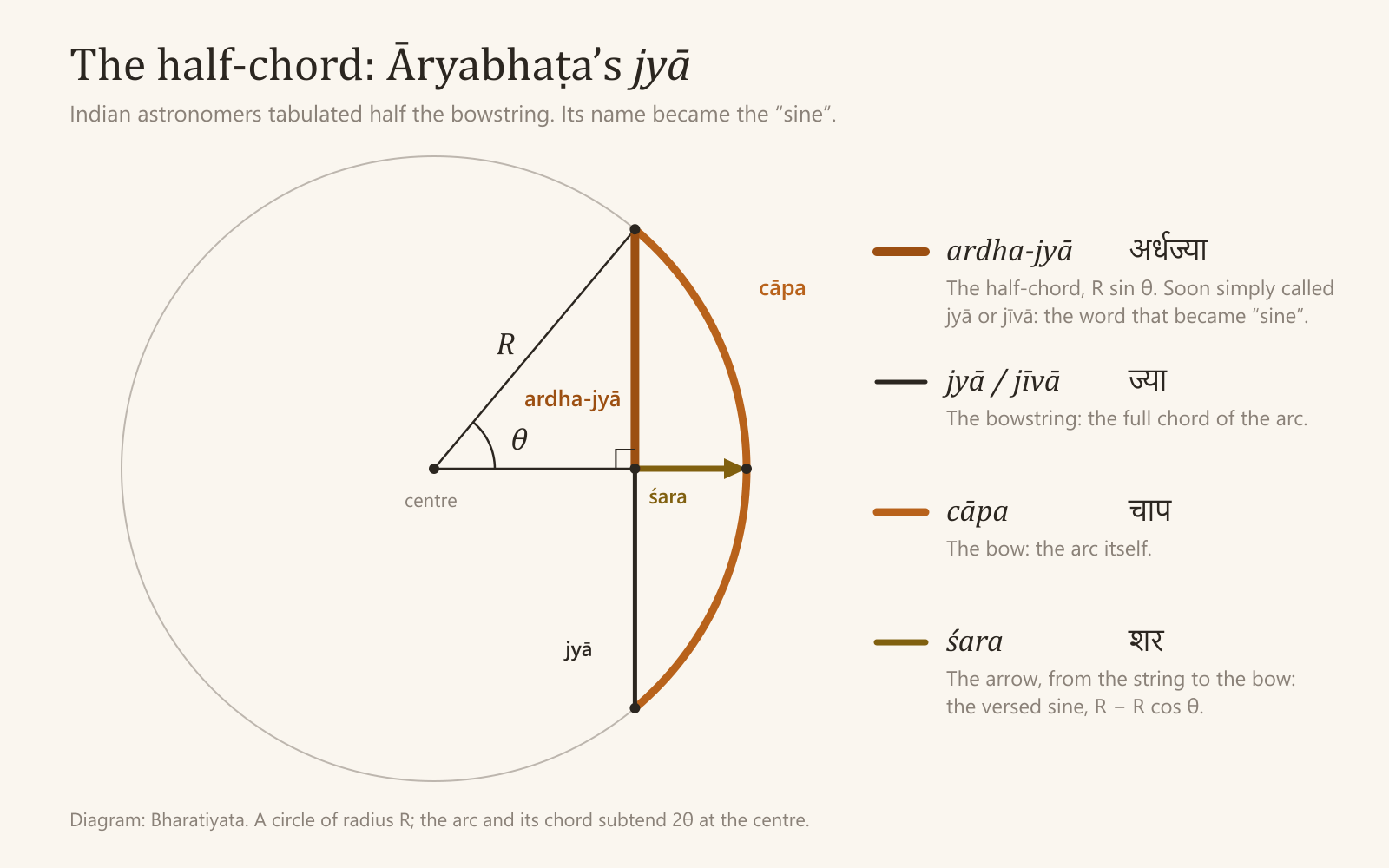
Hellenistic astronomers such as Hipparchus and Ptolemy worked with chords. Picture a circle as an archer’s bow: the arc is the curved stave, and the straight line joining its ends is the bowstring, or chord. Ptolemy’s Almagest tabulates the lengths of chords for a circle whose diameter is divided into 120 parts.
Chords work, but they are awkward for right-angled triangles, because you keep having to halve both the angle and the chord. Indian astronomers tabulated the half-chord instead. In Sanskrit a bow is cāpa or dhanus, and its string is jyā (ज्या) or jīvā (जीवा). Half the string is the ardha-jyā (अर्धज्या), which Āryabhaṭa writes as jyārdha. Because the half-chord was the quantity astronomers used, the prefix was soon dropped and jyā or jīvā alone meant the half-chord: what modern notation writes as R sin θ. The short segment from the middle of the chord out to the arc had its own name, śara, the arrow notched against the string. Today we call it the versed sine.
Āryabhaṭa’s Āryabhaṭīya is probably the earliest surviving text to give a table of these half-chords in the form of differences. In it he says he was twenty-three years old when 3,600 years of the Kali age had passed, which corresponds to 499 CE. Whether he composed the work in that same year is debated.
Twenty-four differences in a single verse
Āryabhaṭa measured the circumference of his circle in minutes of arc: 360 × 60 = 21,600. A circle with that circumference has a radius of about 3,438 minutes (21,600 ÷ 2π ≈ 3,437.75), so his half-chords are scaled to R = 3,438.
He divided a quarter of the circle into twenty-four equal steps of 225 minutes (3° 45′). He then recorded not the twenty-four half-chords themselves but their successive differences: 225, 224, 222, 219, 215, 210, and so on down to 7. Added together, the twenty-four differences come to exactly 3,438, the radius. In his alphasyllabic notation, consonants carry numerical values and vowels mark powers of a hundred. That let him fit all twenty-four numbers into a single stanza: verse 12 of the Gītikāpāda in the critical edition by K. S. Shukla and K. V. Sarma (verse 10 in W. E. Clark’s older numbering). A student who memorised it carried a complete table in a few lines of verse.
A later stanza, Gaṇitapāda 12, states a rule for producing those differences. Each difference is the first one (225) diminished by the sum of all the preceding half-chords divided by 225. Put another way, each difference falls short of the one before it by the preceding half-chord divided by 225. In modern terms, the second difference of the sine is proportional to the negative of the sine itself. That is a step-by-step counterpart of a property calculus students learn much later: the sine’s second derivative is its own negative.
Some eight centuries later, Mādhava of Saṅgamagrāma (c. 1350–1425) and the astronomers of the Kerala school who followed him went further, to infinite series for the sine, cosine and arctangent. Mādhava’s own writings on these series are lost; we know them through his successors.
How jīvā became sinus
Indian astronomical knowledge reached Baghdad in the late eighth century, and al-Khwārizmī’s astronomical tables (zīj), drawing on that Indian material in the early ninth century, include tables of sines. Arabic writers did not translate jīvā by its meaning. They carried its sound across as jiba, written with the consonants j-y-b, since Arabic script usually leaves out short vowels.
Jiba meant nothing in Arabic. Written without vowels, though, it looks the same as jayb, an ordinary word for the fold or pocket of a garment, and later writers read it that way. When Arabic astronomy was translated into Latin, translators rendered jayb by its Latin equivalent, sinus. Accounts differ on exactly where in this chain the change from jiba to jayb happened and which translator first wrote sinus.
From sinus came the English sine. The word cosine is much later. The English mathematician Edmund Gunter proposed co-sinus, the sine of the complementary angle, in 1620.
Every sin θ therefore carries two histories at once: a fifth-century Indian decision to measure half the bowstring rather than all of it, and a chain of Sanskrit, Arabic and Latin readers who carried that table across Eurasia.
A word for a bowstring, misread as a fold of cloth, still names one of mathematics’ basic functions.
Sources and scope
- K. S. Shukla and K. V. Sarma, Āryabhaṭīya of Āryabhaṭa, critical edition with English translation and notes (Indian National Science Academy, 1976): Gītikāpāda 2 and 12, Gaṇitapāda 11–12, Kālakriyāpāda 10, and the editors' introduction on Āryabhaṭa's date and the sine table.
- Walter Eugene Clark, The Āryabhaṭīya of Āryabhaṭa (University of Chicago Press, 1930): an earlier English translation with notes on jyā and śara.
- MacTutor History of Mathematics, “The trigonometric functions”, and its biographies of al-Khwārizmī and Mādhava: Ptolemy's chords, the passage of jīvā into Arabic and Latin, and the Kerala series.
- Florian Cajori, A History of Mathematical Notations, vol. II (Open Court, 1929): Gunter's coinage of “cosine”.
- Kim Plofker, Mathematics in India (Princeton University Press, 2009; ISBN 978-0-691-12067-6), and Glen Van Brummelen, The Mathematics of the Heavens and the Earth (Princeton University Press, 2009; ISBN 978-0-691-12973-0): further reading on Indian trigonometry and its transmission.
This essay is an editorial introduction based on published editions and scholarship; it is not expert-reviewed.
Explore more on Vijñāna: Knowledge systems & sciences, or continue into the Vijñāna reading journey.