
Berenike: Indian Pepper at a Roman Red Sea Port
At Berenike, a Roman port on Egypt's Red Sea, excavators found an Indian jar of pepper, Indian cooking pots and Tamil names: Indians in the Roman trade.
Maritime exchange, food & archaeology · Kerala & the Red Sea · Berenike, Quseir al-Qadim & Muciri
For a long time, the trade between India and the Roman world was known mainly from texts. Pliny the Elder complained that India, China and Arabia took a hundred million sesterces a year from the Roman Empire. An anonymous Greek merchant’s handbook, the Periplus Maris Erythraei (mid-first century CE), lists the ports and cargoes. An early Tamil poem, Akanāṉūṟu 149, describes the ships of the Yavaṉar arriving at the Chera port of Muciri (Muziris) with gold and leaving with pepper.
Texts leave an open question. Did Roman ships sail to Kerala while Indians stayed on the Malabar shore, or did Indian merchants and sailors also cross the Arabian Sea and live in the ports of Roman Egypt? Excavations on Egypt’s Red Sea coast have begun to answer that question with pottery, timber, cloth and seeds.
Seven and a half kilograms of pepper
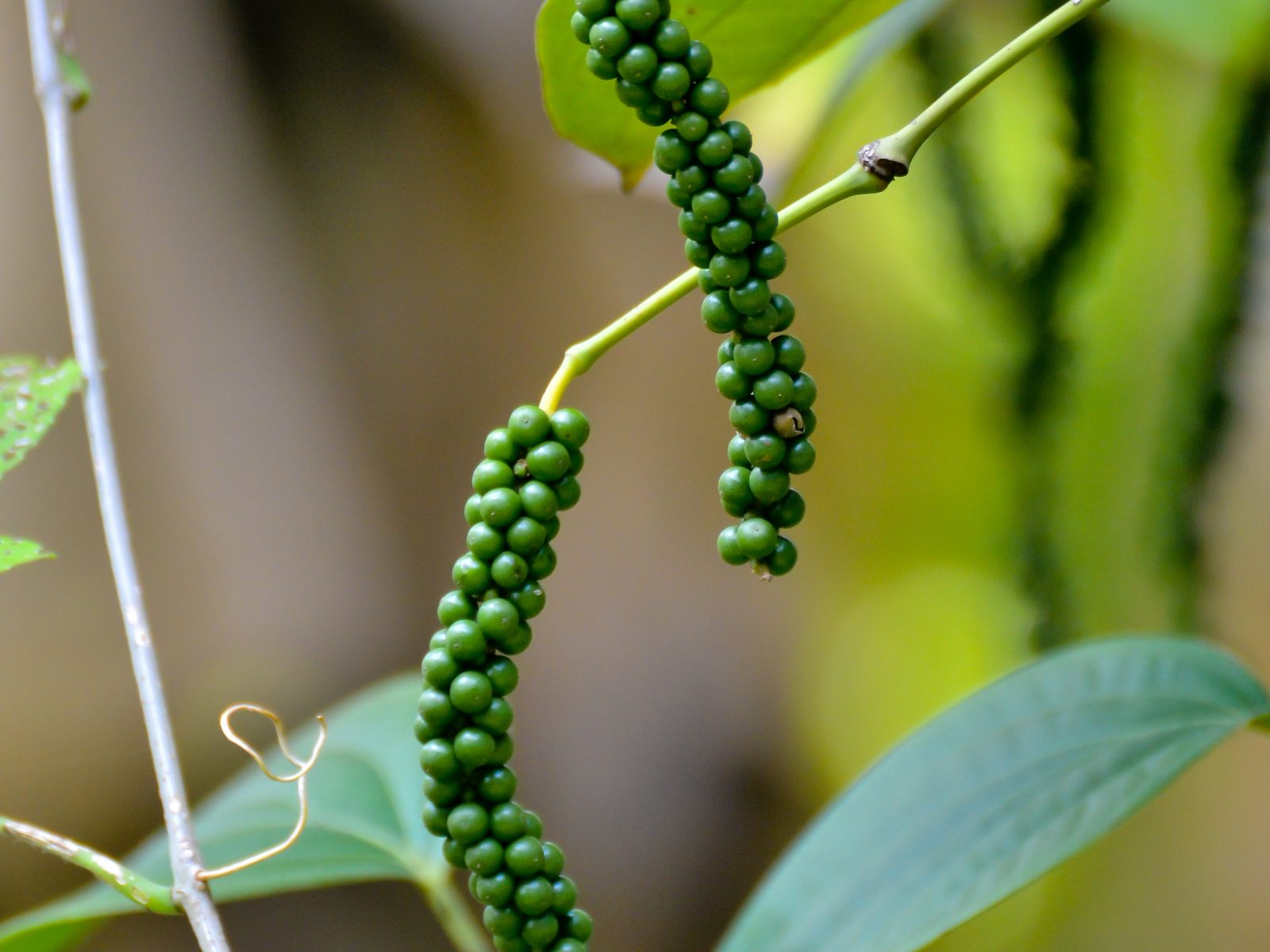
Berenike was a Ptolemaic and Roman harbour town on Egypt’s southern Red Sea coast. From 1994 to 2001 excavations there were directed by Steven Sidebotham and Willeke Wendrich, and the dry climate preserved organic remains that rarely survive elsewhere. In the 1999 season the team found a large storage jar set into the courtyard floor of the so-called Serapis temple. The jar was made in India and held about 7.5 kilograms of first-century black peppercorns (Piper nigrum). The pepper vine is native to the forests of India’s south-western Western Ghats.
A single peppercorn in an archaeological sieve is significant. Several kilograms stored in an Indian vessel inside an Egyptian temple compound show the scale at which pepper moved across the western Indian Ocean. In Rome, pepper runs through the recipe collection attributed to Apicius, and the emperor Domitian built warehouses for it, the horrea piperataria. In Akanāṉūṟu 149 it is kaṟi, the cargo the Yavana ships carried away from Muciri in exchange for gold (பொன், poṉ).
Cooking pots and Tamil names
Everyday objects say even more about who was at these ports than luxury cargo does. At Berenike, and at the northern port of Myos Hormos (Quseir al-Qadim), the commonest Indian pottery is not trade ware but red-slipped cooking pots and casseroles. Some are made with a technique known from northern Kerala. Roberta Tomber, who studied this pottery, suggests these may have been the personal possessions of Indians living there. Rice and mung beans have also been found at Berenike, and the archaeobotanists suggest the rice may have been imported to feed Indian merchants in the town.
People also wrote their names. At Quseir al-Qadim, first-century sherds carry Tamil-Brāhmī graffiti, read by Iravatham Mahadevan as the personal names Kaṇaṉ and Cātaṉ. At Berenike, a sherd of a Roman wine amphora carries a Tamil-Brāhmī inscription that Mahadevan read as Koṟṟaṉ, though later excavators consider that reading doubtful. Farther south, on the island of Socotra at the mouth of the Gulf of Aden, Indian visitors to the Hoq cave left nearly two hundred inscriptions, mostly in Brāhmī script, between the second and early fifth centuries CE. Several of the writers call themselves men of Bharukaccha, modern Bharuch in Gujarat.
Even building materials and rubbish carry Indian traces. Recycled teak ship timbers were used to stabilise the walls of late Roman buildings at Berenike, and resist-dyed Indian textiles turn up in its late Roman rubbish.
Who were the Yavanas?
In Sanskrit and Prakrit, Yavana (यवन; Prakrit Yona; Tamil Yavaṉar, யவனர்) most likely comes from the Old Persian Yauna, “Ionian”, and first named Greeks. In early Tamil poems the word describes sea-going westerners, some of them living in India. Later still it came to be used for Arabs.
Puṟanāṉūṟu 56, by the poet Nakkīraṉār and addressed to the Pandya king Naṉmāṟaṉ, pictures bangled women serving the king cool, fragrant wine brought by the Yavanas, poured from vessels worked in gold. The later Tamil epic Cilappatikāram describes Yavana dwellings at the Chola port of Puhār. An earlier poem about Puhār, the Paṭṭiṉappālai, speaks more generally of people from many lands, speaking many languages, living together in the city.
Read alongside the cooking pots and graffiti of the Red Sea ports, these poems no longer describe a one-way visit. Pliny reports that ships could reach Muziris from the Red Sea in about forty days with the monsoon wind. The Periplus lists cotton cloth exported from Barygaza (Bharuch) and fine muslins from the Pandya coast. Seasonal winds linked the pepper hills of Kerala and the ports of western and southern India to the harbours of Roman Egypt, and people as well as goods travelled both ways.
A jar of pepper in an Egyptian temple courtyard is evidence of Indians at work on both shores of the Arabian Sea.
Sources and scope
- Steven E. Sidebotham, Berenike and the Ancient Maritime Spice Route (University of California Press, 2011; ISBN 978-0-520-24430-6), and S. E. Sidebotham and I. Zych, “Berenike: archaeological fieldwork at a Ptolemaic-Roman port on the Red Sea coast of Egypt 2008–2010”, Sahara 21 (2010): the excavations, the teak timbers and Indian textiles. The year and place of the 1999 find are described in the University of Delaware research magazine.
- Roberta Tomber, “Quarries, Ports and Praesidia: Supply and Exchange in the Eastern Desert”, in The Eastern Desert of Egypt during the Greco-Roman Period: Archaeological Reports (Collège de France, 2018), and her Indo-Roman Trade: From Pots to Pepper (Duckworth, 2008; ISBN 978-0-7156-3696-1): Indian cooking pots at Berenike and Myos Hormos.
- René Cappers, Roman Foodprints at Berenike (Cotsen Institute of Archaeology, 2006; ISBN 978-1-931745-26-0), summarised in this Bryn Mawr Classical Review: the pepper jar, rice and mung beans.
- Iravatham Mahadevan, Early Tamil Epigraphy (Cre-A and Harvard University, 2003; ISBN 978-0-674-01227-1), and a 2025 study of Indians at Berenike by Sidebotham and colleagues in the Jahrbuch des Deutschen Archäologischen Instituts: the Tamil-Brāhmī graffiti and their readings.
- Ingo Strauch (ed.), Foreign Sailors on Socotra: The Inscriptions and Drawings from the Cave Hoq (Hempen, 2012; ISBN 978-3-934106-91-8): the Hoq inscriptions.
- Jeremy A. Simmons, “Behind gold for pepper: The players and the game of Indo-Mediterranean trade”, Journal of Global History 18.3 (2023), pp. 343–364: who took part in the trade, including Indian traders at Berenike.
- Klaus Karttunen, Yonas and Yavanas in Indian Literature, Studia Orientalia 116 (Finnish Oriental Society, 2015; ISBN 978-951-9380-88-9): the history of the word Yavana.
- Tamil texts: Akanāṉūṟu 149 (Project Madurai; Vaidehi Herbert’s translation), Puṟanāṉūṟu 56 (Project Madurai; translation), Paṭṭiṉappālai (translation) and Cilappatikāram canto 5 (Project Madurai).
- Roman and Greek texts: Pliny, Natural History 6.26 and 12.41 (Perseus); Lionel Casson, The Periplus Maris Erythraei (Princeton University Press, 1989; ISBN 978-0-691-04060-8), with W. H. Schoff's 1912 translation online (sections 49 and 59); the horrea piperataria in Platner and Ashby’s Topographical Dictionary of Ancient Rome.
- Photograph: Black Pepper (Piper nigrum) fruits.jpg by K Hari Krishnan, CC BY-SA 3.0, via Wikimedia Commons; cropped and resized for this page and shared under the same licence.

This is an introductory reading drawing on excavation reports and published scholarship; it is not expert-reviewed.
Explore more on Pravāsa: Journeys & cultural exchange, or follow the food thread through Āhāra: Food & foodways.