
Āhāra · Bhāṣā & Vāṅmaya · Samāja
Rice and Ragi: Kanakadāsa's Rāmadhānya Caritre
In Kanakadāsa's Rāmadhānya Caritre (Ramadhanya Charitre), finger millet argues with rice before Rāma over which grain is best and who keeps people alive.
Food, hierarchy & agrarian life · Kannada · Kanakadāsa’s Rāmadhānya Caritre
Which grain deserves greater honour: rice, which belongs at sacred rites and feasts, or finger millet, which keeps people alive when the rains fail?
The sixteenth-century Kannada poet-saint Kanakadāsa turns that question into a trial in Rāmadhānya Caritre (often spelt Ramadhanya Charitre), “the story of Rāma’s grain”. In the poem, the sage Śāṇḍilya tells the tale to Yudhiṣṭhira. After the war in Lanka, on his way home, Rāma camps in a great forest where the sage Gautama and other sages receive him. Hanumān asks to see the grains of the land, and the sages’ disciples bring nine of them.
Rāma asks which grain is best. Gautama names finger millet, naredalega (ನರೆದಲೆಗ, literally “grey-head”), as the best for their country. Rice, vrīhi, accuses him of bias, and the argument begins.
What rice claims, and how millet answers
Rice speaks of its place in ritual life. It is needed for the sacred-thread ceremony, for food offered to the deity, for feasts given to Brahmins, for the rice grains showered at weddings, for house-warmings and for the worship of weapons. It dismisses finger millet as low-born food without lineage.
Finger millet answers from a different place. When the rains fail and crops vanish in famine, it says, it keeps living creatures alive. Rice runs after the rich, while millet protects rich and poor alike.
Rāma does not settle the matter by decree. He orders both grains to be imprisoned for six months and leaves them in the sages’ keeping. When he later sends for them (the poem says after seven months), Hanumān fetches the two “prisoners”. The gods and sages examine them. Indra and Nārada find that the millet has kept its lustre, while the rice has wasted and faded.
Rāma then gives the winning grain his own name, Rāghava. The poem presents this as the origin of the word rāgi (ರಾಗಿ). Linguists need not accept that derivation; the poem offers it as a story that gives a common grain a royal name.
A poem rooted in dryland food
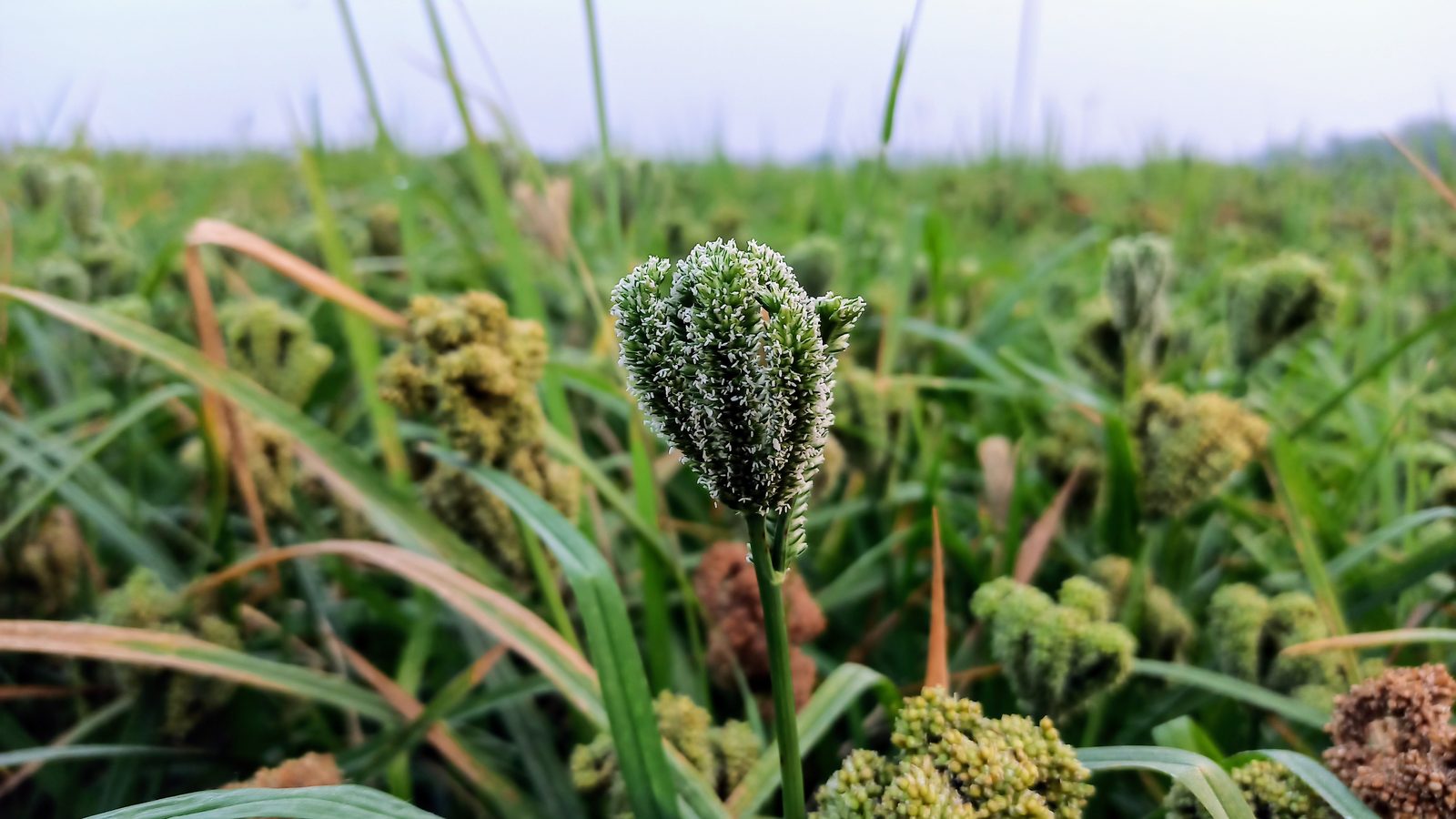
The argument works as poetry because it rests on agricultural fact. Finger millet (Eleusine coracana), rāgi in Kannada and Telugu and kēḻvaragu in Tamil, came to South Asia from Africa in prehistory. It became one of the most productive grains of India’s dry-cropping regions. It grows without irrigation on poor soils, and a recent scientific review reports that its grain can resist storage pests for as long as ten years.
The editors of the Kannada edition read the poem as exposing differences of class and varṇa. The Sahitya Akademi’s Encyclopaedia of Indian Literature reads the millet as standing for the poor and rice for the rich. Either way, the poem asks a court of gods and sages to judge food not by the rites it adorns but by whether it keeps people alive in a hard season.
A staple of the drylands asks to be judged by whom it sustains.
Sources and scope
- Kanakadāsa, Rāmadhānya Caritre, in Kanaka Sāhitya Darśana, vol. 2, ed. S. S. Marulaiah (Department of Kannada and Culture, Government of Karnataka), pp. 38–74: the Kannada text of the poem. A searchable copy of the same text has been uploaded separately.
- E. P. Rice, A History of Kanarese Literature, 2nd ed. (Association Press / Oxford University Press, 1921), pp. 80–81: summary of the poem, the trial and the name Rāghava.
- Amaresh Datta (ed.), Encyclopaedia of Indian Literature, vol. III (Sahitya Akademi, 1989), “Kanakadasa”, pp. 1959–1961: the poet's dates and a reading of the poem.
- Dorian Q. Fuller and Nicole Boivin, “Crops, cattle and commensals across the Indian Ocean”, Études Océan Indien 42–43 (2009), pp. 13–46: the African origin of finger millet and its place in India's dry-cropping regions.
- Sanjay Mohan Gupta and others, “Finger Millet: A ‘Certain’ Crop for an ‘Uncertain’ Future and a Solution to Food Insecurity and Hidden Hunger under Stressful Environments”, Frontiers in Plant Science 8 (2017): growth without irrigation and storage life.
- University of Madras, Tamil Lexicon, “kēḻvaragu”.
- Photograph: Finger Millet Field at Peddamunagalachedu Village.jpg by Kavali Chandrakanth KCK, CC BY-SA 4.0, via Wikimedia Commons; resized for this page and shared under the same licence.

This essay is an editorial introduction to a Kannada poem and to published scholarship on finger millet; it is not expert-reviewed and makes no nutritional or medical claim.
Explore more on Āhāra: Food & foodways, or follow its literary world through Bhāṣā & Vāṅmaya.