Ilkal: Where Threads Remember
In the meeting of body and pallu, Ilkal holds a quiet lesson: heritage survives through the hands that make it, the lives that wear it, and the care that carries it forward.
A saree can be read from its edges. Before we ask its age or price, we can follow the border, notice the change of colour, and look for the place where one field of threads meets another. In an Ilkal saree, that meeting is a useful place to begin.
Named for the weaving town in Karnataka’s Bagalkot region, Ilkal belongs to a textile landscape larger than any single garment. Its identity rests in the decisions that make cloth recognisable: the relationship between body and pallu, the rhythm of its borders, and the confidence of contrasting colour.[1]
The intelligence of a join
The defining construction is known as tope teni. The warp for the body and the warp for the pallu are prepared separately and connected through loops. This is a joining of threads within the making of the cloth, rather than a finished pallu simply stitched onto a finished body. India Handloom Brand identifies this looped connection as a distinguishing feature.[1]
There is an appealing thought here. Continuity need not mean sameness. Two sections can retain their character and still become one fabric. As an editorial metaphor, the join offers a way to think about inheritance: something received, something brought to it, and patient work at the meeting point.
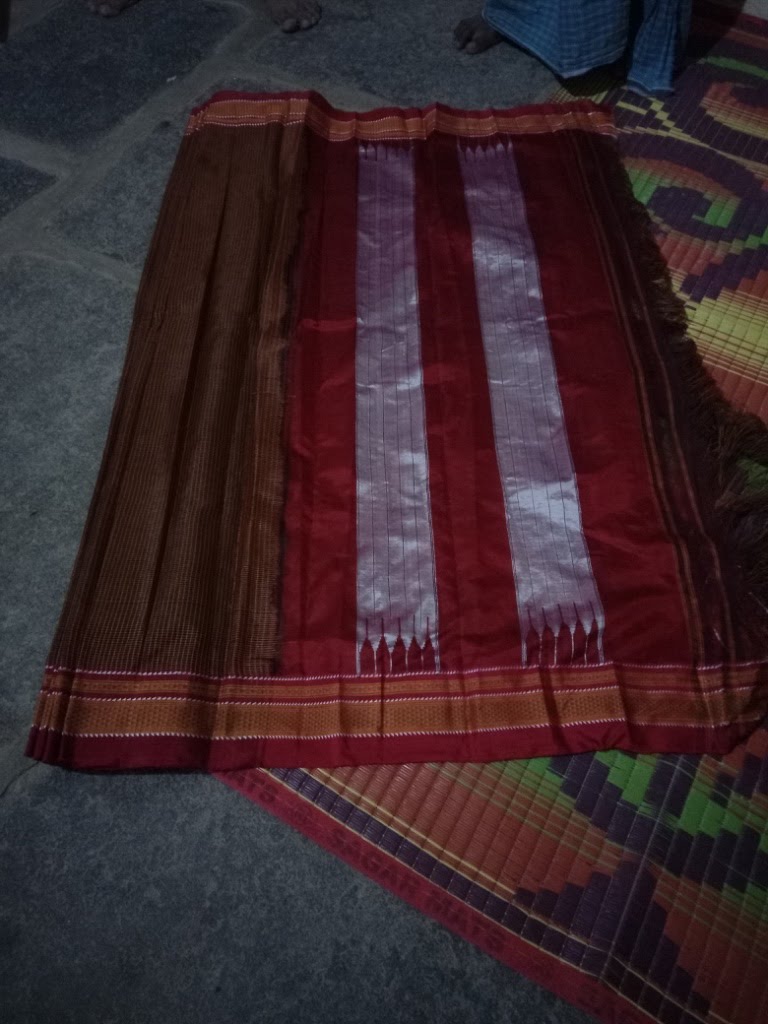
Ilkal saree. Photograph: T B Dinesh / The Handmade March, 2018. Wikimedia Commons, CC0 1.0.

A vocabulary in colour
Red and white give many Ilkal pallus their striking visual cadence. Bodies may be plain, striped or checked; borders introduce another measured register. Gomi and chikki paras are among the border names documented by D’source. Materials vary too: cotton, silk and art silk occur in different combinations.[2]
These differences matter. An Ilkal is not a single, unchanging recipe. Looking closely means asking what a particular saree is made of, how it was woven, and who made it. The name is an invitation to learn those distinctions, not a substitute for them.
Memory without a glass case
When we say that threads remember, we are speaking figuratively. Cloth does not carry an account of every life it touches. People do: through the way they fold a saree, describe its border, choose it for an occasion, or recognise a familiar colour across a room.
A living textile asks to be encountered at that human scale. Its beauty can sit in an ordinary cupboard as easily as in an exhibition. Use gives it another kind of attention: the small practical knowledge of wearing, storing, repairing and caring for something over time.
The danger in writing about heritage is that admiration can make people disappear. We celebrate “timeless” cloth and forget the time required to make it. We praise tradition and leave its makers unnamed. A more attentive appreciation begins with questions and allows the answers to complicate the picture.
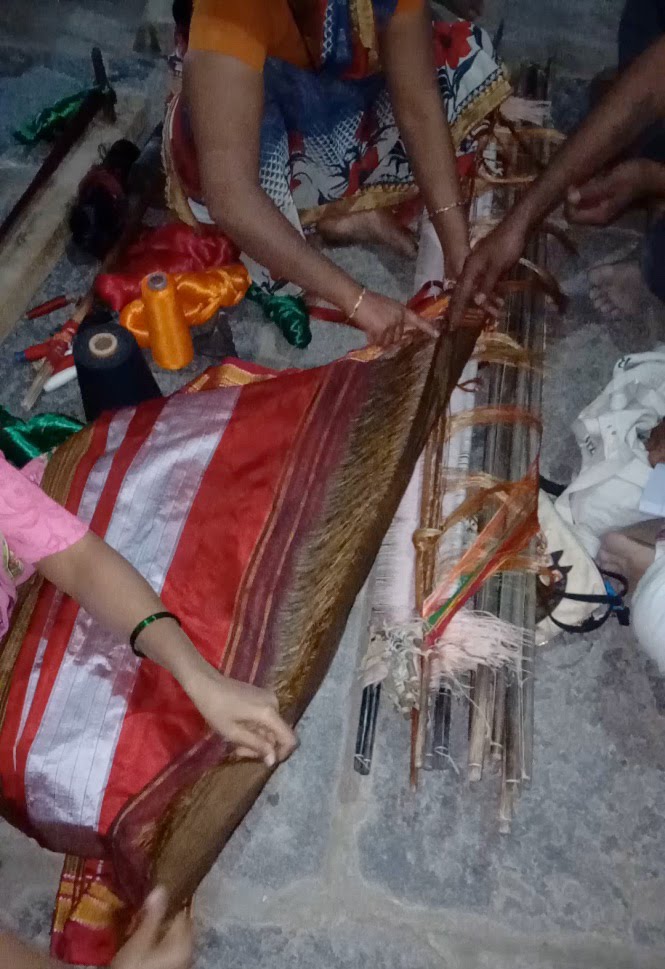
Ilkal weaving, documented during The Handmade March. Photograph: T B Dinesh, 2018. Wikimedia Commons, CC0 1.0. This archival photograph does not document a Bharatiyata field visit.

What we carry forward
D’source documents both handloom and powerloom production in the Ilkal tradition.[2] That makes precise descriptions essential. A regional name alone should not stand in for a claim about the loom, fibre or maker of an individual piece.
For the wearer, collector or curious reader, care can begin simply: ask for the fibre composition and weaving method; seek the maker’s or producer’s name; request care instructions suited to that cloth. For a cultural organisation, care also means crediting photographs, distinguishing research from first-hand reporting, and making room for weavers to speak in their own words.
Ilkal’s quiet invitation is to pay attention. To see the join. To notice the labour inside a line of colour. To let beauty lead us towards a relationship with the people who sustain it.
Perhaps that is how threads remember: through what we choose to remember with them.
Sources and image credits
This is a research-based editorial essay, not first-hand field reporting. The reflections on memory and continuity are the author’s interpretation.
- India Handloom Brand — Ilkal Saree: place, materials and tope teni construction.
- D’source, NID Bengaluru — Ilkal Saree: Introduction and Weaving: visual vocabulary, material variations and production methods.
Both photographs are by T B Dinesh, sourced from The Handmade March via Wikimedia Commons. Each file’s description page specifies CC0 1.0 Universal Public Domain Dedication. Licence and source checked on 16 October 2026. No retailer images or generated reconstructions are used.