
Until She Returns: Kolkata’s Durga Puja
As Dussehra gives way to everyday life, photographs of Kolkata’s Durga Puja invite a slower look at its pandals, its many images of the goddess, and the artistry we carry into memory.
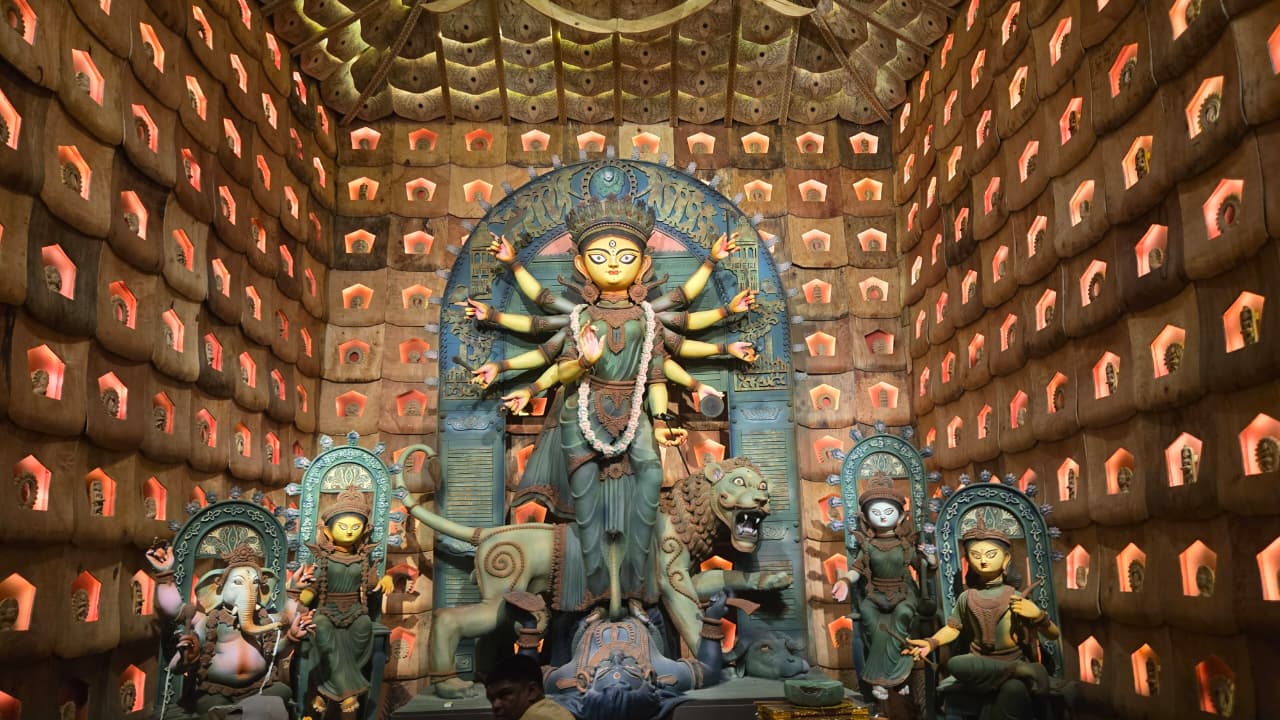
After the farewell, we return to the photographs. A face framed by light. A ceiling we might have hurried beneath. A passage where everyone seems to have stopped, phone in hand, trying to hold on to the same moment.
With Dussehra behind us, this selection from Kolkata’s Durga Puja offers a second, slower visit. The pictures move between entrances, interiors and images of the goddess. Seen together, they reveal how much there is to notice around the central act of worship: colour, scale, repetition, and the many decisions that turn a space into a place of gathering.
The celebration begins at the entrance
In one photograph, boats and tall sails rise against the night sky. Warm light catches their surfaces; visitors’ phones enter the frame below. The approach already has a story to tell before the viewer reaches the goddess.
A pandal is a temporary pavilion created for the festival. Here, its entrance becomes an invitation to step out of an ordinary street and into a composed world. The change in scale matters. We look up, slow down, and begin to follow the shapes.
Elsewhere, curving walls are covered with small pot forms. Bundled, branch-like elements stretch across the passage overhead, while red and blue light change the appearance of the surfaces. Repetition gives a familiar shape an unfamiliar presence. One vessel would fit in the hand; many together become an environment.
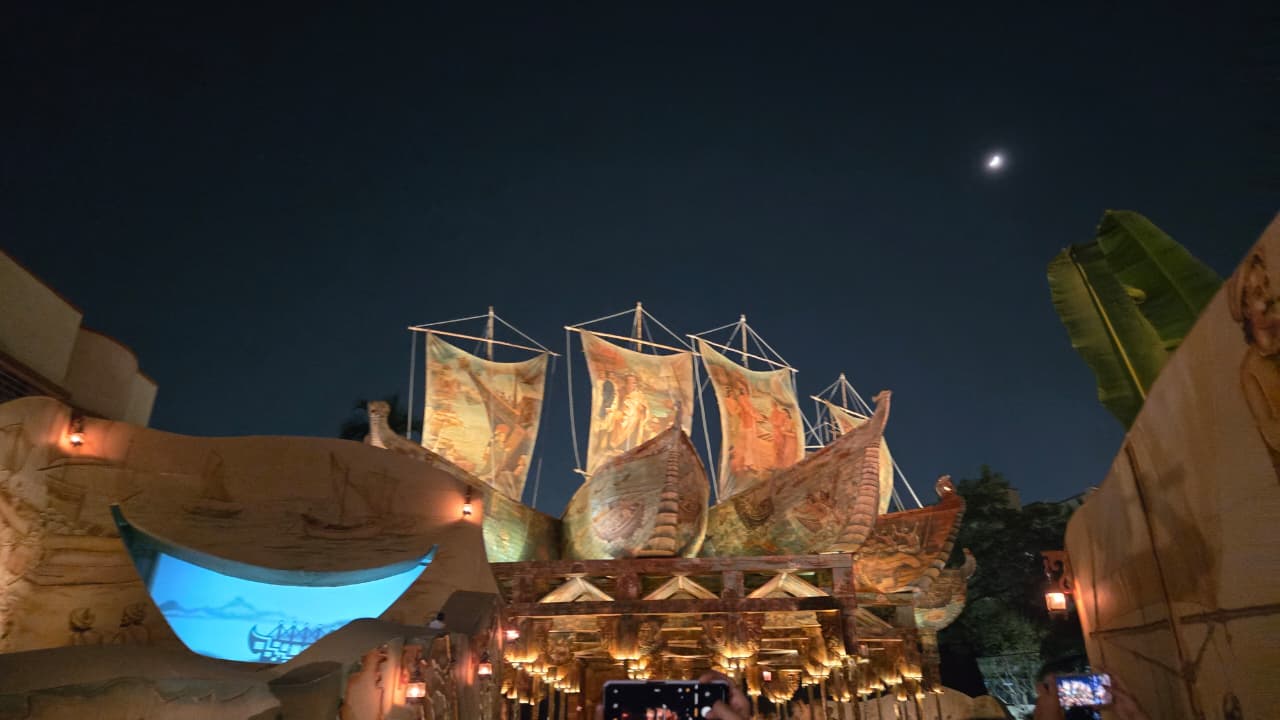
An entrance composed of boats and sails turns the approach to a pandal into part of the spectacle. Photograph: Arindam Das.
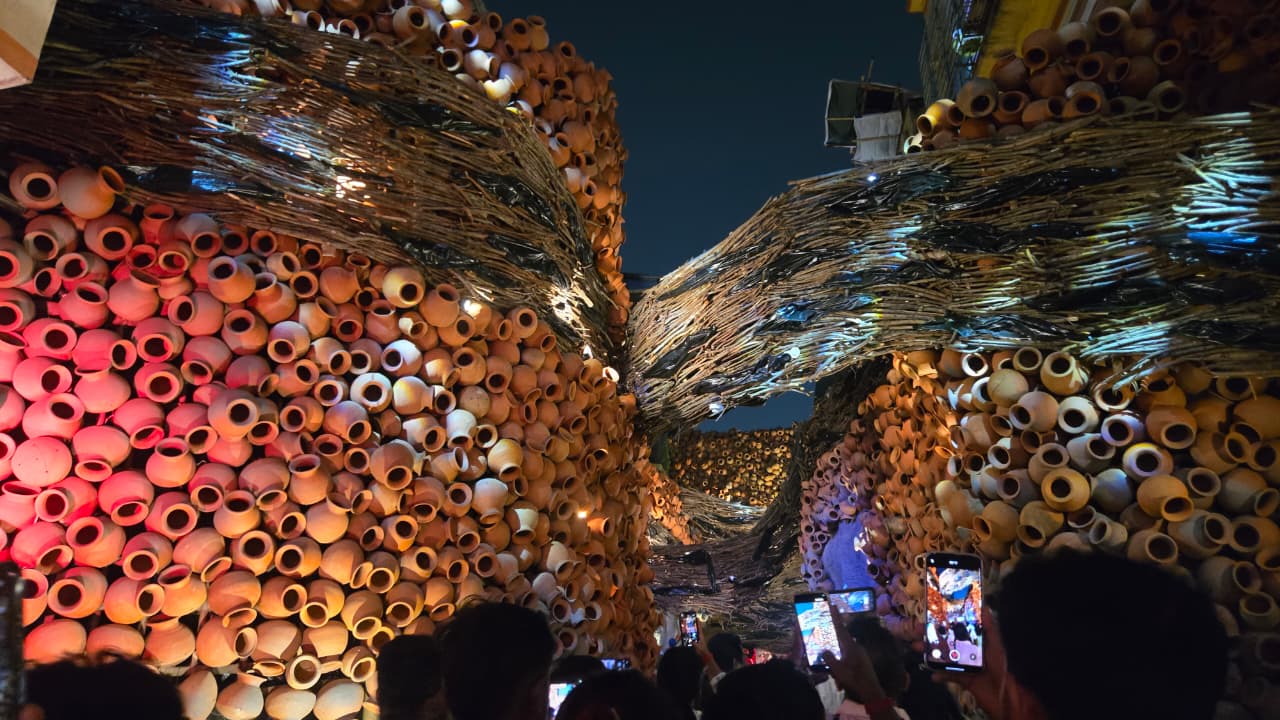
Repeated pot forms cover the walls of a passage as visitors pause to photograph the installation. Photograph: Arindam Das.
Look above the crowd
Another interior rewards an upward glance. Rows of bright flowers run beneath the roof. Patterned columns meet crosspieces, and perforated hanging lights scatter points of brightness. There is no single detail doing all the work: the effect comes from the relationship between them.
These photographs invite us to look past the first impression of grandeur. Notice how a border is repeated, how a light picks out an edge, how an overhead pattern continues the rhythm of a wall. Such choices guide a visitor’s attention even when the people who made them remain outside the frame.
UNESCO’s account of Kolkata’s Durga Puja describes the artisanal workshops that prepare clay images of Durga and her family in the months before the festival.[1] The finished image is the part most visitors encounter. Behind it lies a longer period of preparation and skilled work.
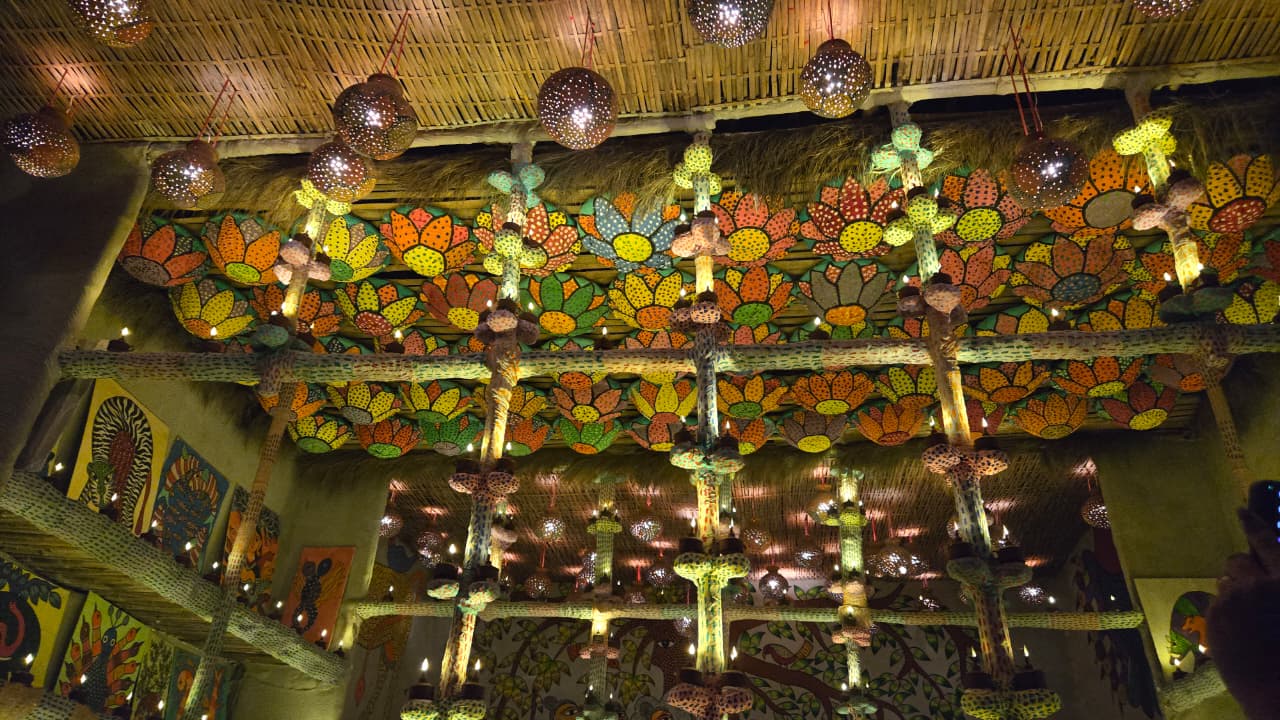
Flowers, patterned columns and hanging lights carry the design above the visitor’s eye level. Photograph: Arindam Das.
One goddess, different visual worlds
The images of Durga in this collection do not settle into a single visual language. In one, a richly decorated gold-toned backdrop gathers the figures into a broad, ceremonial arrangement. Deep red curtains intensify the colours; garlands and offerings fill the foreground.
In the lead photograph, teal-green tones and a stylised lion create a different mood. Small illuminated niches repeat across the surrounding walls, drawing the eye back towards the central figure. The room and the tableau seem to answer one another.
A quieter palette appears in the photograph of a pale-sari Durga holding a small Ganesha. The maternal gesture draws attention even as the lion and defeated figure remain at her feet. Without knowing the artist’s stated theme, we can still notice how tenderness and power share the same image.
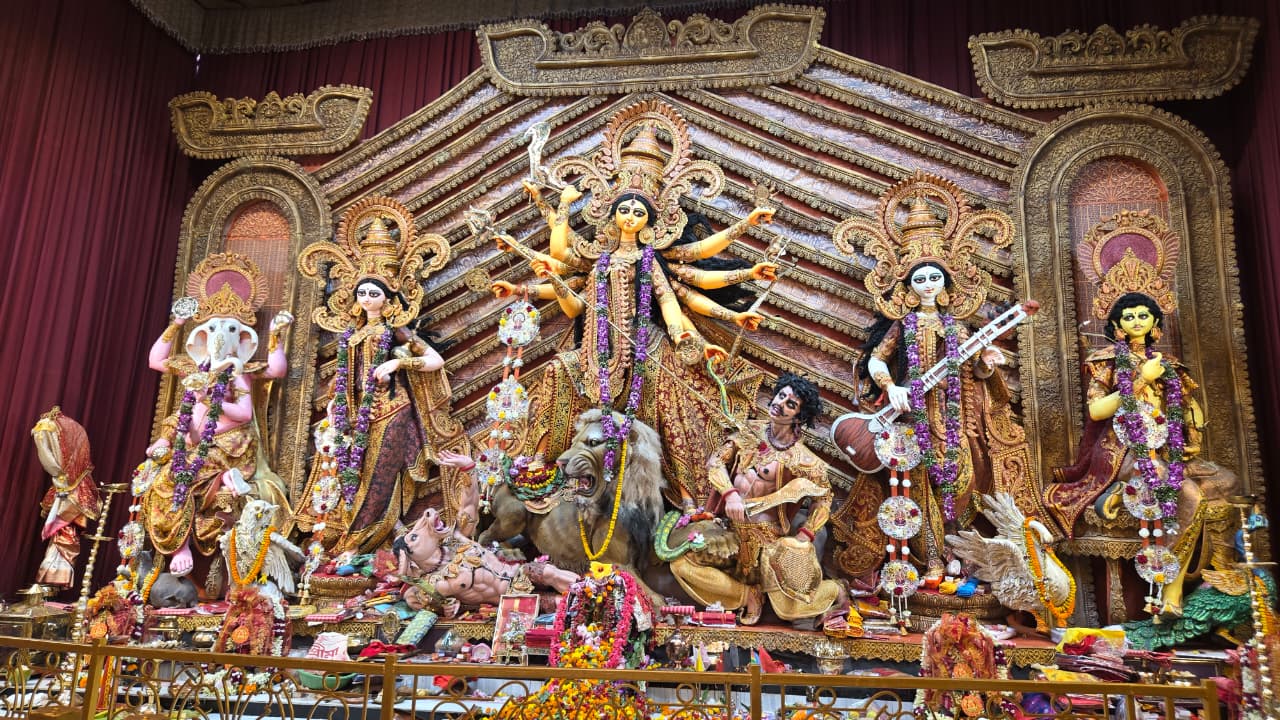
A gold-toned tableau brings Durga and the accompanying deities together beneath an ornate backdrop. Photograph: Arindam Das.
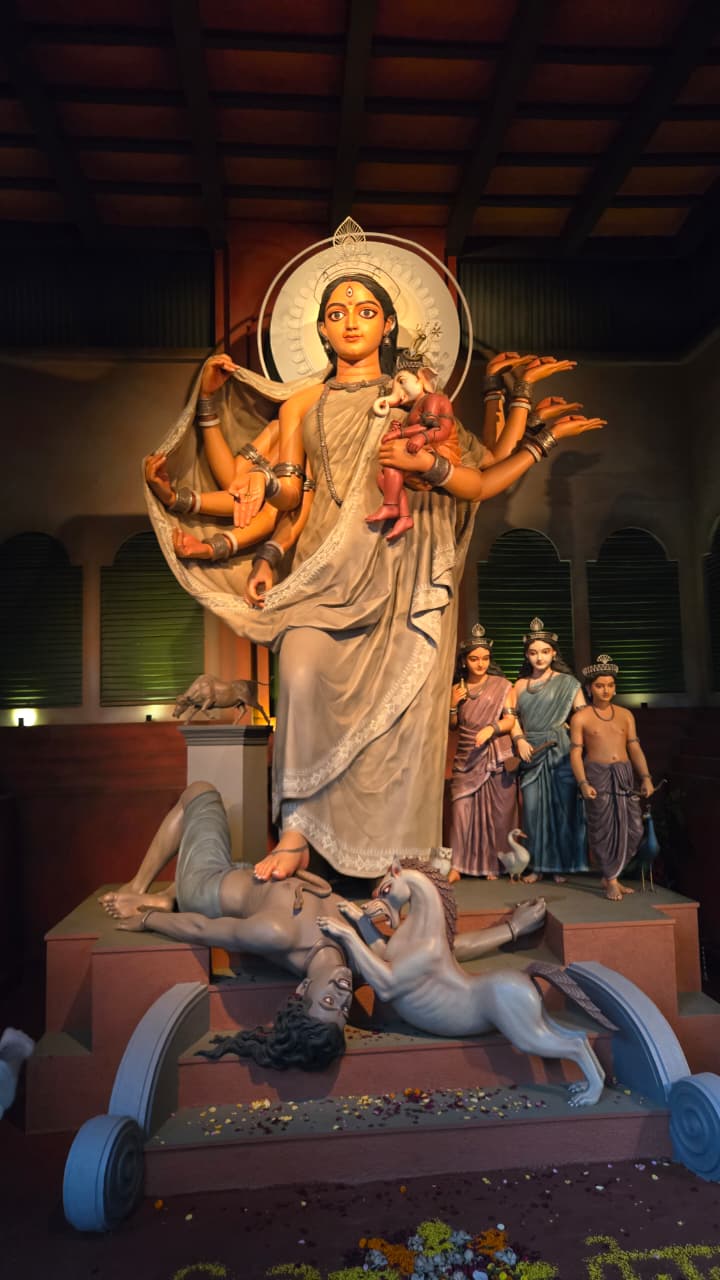
A pale-sari interpretation places a small Ganesha in Durga’s arm, bringing a maternal gesture into the image. Photograph: Arindam Das.
What the farewell carries
Durga Puja’s emotional world includes the goddess’s homecoming with her children and the departure marked by immersion at the festival’s close.[2] That movement helps explain why an ending can carry affection as well as celebration. The farewell leaves room for another arrival.
In 2021, UNESCO inscribed “Durga Puja in Kolkata” on its Representative List of the Intangible Cultural Heritage of Humanity.[3] The recognition concerns a living cultural practice. Its continuity depends on people: those who make, organise, worship, visit and pass on what the occasion means to them.
For Bharatiyata, these photographs are a beginning for that attention. A beautiful image can lead us towards the maker behind a face, the designer behind a passage, or the neighbourhood that brought a pandal into being. Keeping their names alongside the pictures would make the memory richer.
For now, look once more at the raised phones in the passage. Each holds a small version of the same shared space. The festival has given its visitors something to carry away—and a reason to return.
Aschhe bochhor abar hobe—next year, it will happen again.
Sources and photographs
This photo essay draws on photographs supplied to Bharatiyata and published cultural sources. It is an editorial reflection, not a report of interviews or a documented Bharatiyata field visit. Pandal names, artists and capture dates have not been independently established; captions describe visible details.
[1] UNESCO — Durga Puja in Kolkata: the festival and image-making workshops.
[2] Incredible India, Ministry of Tourism — Durga Puja: homecoming and the festival’s closing observances.
[3] Ministry of Culture / Press Information Bureau, 15 December 2021: UNESCO inscription.
Photographs: Arindam Das. Supplied to Bharatiyata.