
Śilpa · Vijñāna / Śāstra · Samāja
Rāṇī kī Vāv: The Queen's Stepwell at Patan
Rani ki Vav, the eleventh-century Queen's Stepwell at Patan in Gujarat, descends westward through seven storeys of pillared pavilions and sculpture to water.
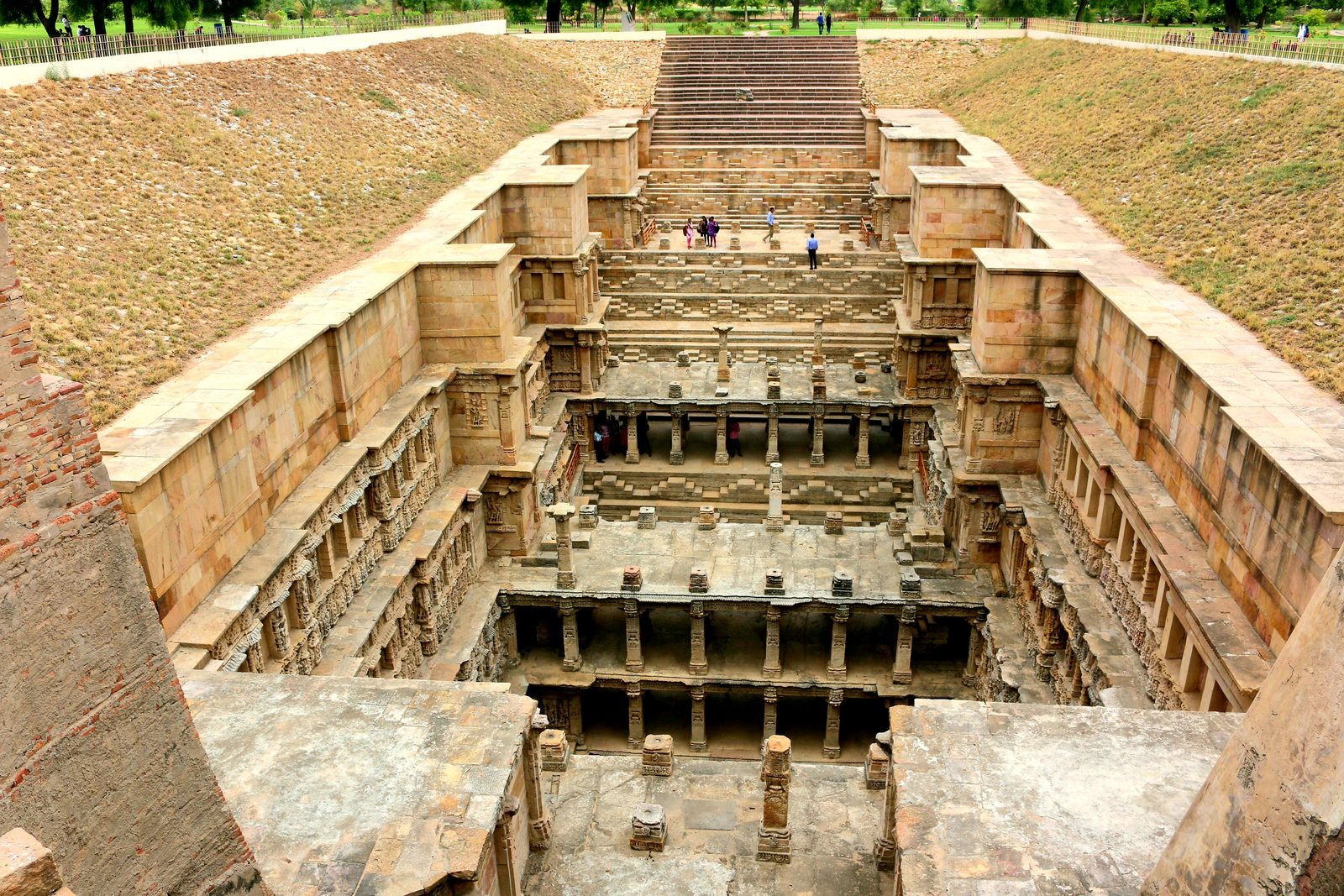
Architecture, water & civic life · Gujarat · Rāṇī kī Vāv and the western stepwell tradition
Most monuments ask us to look up. A stepwell (vāv in Gujarati, વાવ; bāolī in Hindi) invites us to walk down into the ground.
In much of Gujarat and Rajasthan, the rain comes in a few monsoon months. In the dry season, as the archaeologist Kirit Mankodi writes of Patan, the water level sinks far below the ground. A plain vertical well can only be reached with a rope. A stepwell cuts a long, stepped corridor into the earth, so that people can walk down to the water at whatever depth the season has left it.
An inverted temple in seven storeys
At Patan in northern Gujarat, Rāṇī kī Vāv, “the queen’s stepwell”, carries this idea to a monumental scale. UNESCO, which inscribed it as a World Heritage Site in 2014, describes it as an inverted temple. The entrance is at the eastern end, and from there the corridor descends westwards, terrace by terrace, to a deep well shaft at the western end. The corridor walls once rose in seven terraces. Pillared pavilions of two, four, six and seven storeys mark the way down, and the well shaft itself has seven levels.
The stepwell dates from the eleventh century. Its traditional association is with Queen Udayamatī, queen of the Chaulukya king Bhīmadeva I, who reigned from 1022 to 1064. The fourteenth-century chronicle Prabandhacintāmaṇi records that Udayamatī built a new reservoir at Patan. Identifying that reservoir with this stepwell, and reading the stepwell as her memorial to the king, is the interpretation of Mankodi’s study for the Archaeological Survey of India. A later image in the well carries the inscription “Mahārājñī Śrī Udayamatī”.
Along the walls, carvers placed hundreds of sculptures. Some four hundred large images survive, of at least eight hundred planned. Viṣṇu appears more often than any other deity, including his Varāha and Vāmana forms. Around him are celestial women (apsarās) and a serpent maiden (nāgakanyā), among many other figures. Some of the geometric wall patterns, Mankodi notes, are still woven today in Patan’s paṭolā silk.
In the thirteenth century the Sarasvatī river flooded and silted the stepwell up. The well shaft remained visible, but the rest of the monument was buried, and the silt protected the carvings. Work to uncover it began in 1937. Most of the silt was removed in the 1980s, and conservation was completed in 2008.
Water as a public gift
In classical Indian law, dedicating wells, tanks, temples and gardens for public use was pūrta, a meritorious gift. A vāv was at once a work of hydraulic engineering and an act of that kind. Built underground, stepwells also stay cool: studies of stepwells in northern India have recorded comfortably cool interiors.
A stepwell reminds us not to separate utility from beauty too quickly. Anyone who came for water at Patan walked down through a gallery of sculpture to reach it.
By building downward instead of upward, stone craft turned the search for water into a descent through art.
Sources and scope
- Kirit Mankodi, Rani-ki-Vav, Patan (Archaeological Survey of India, 2012): plan and orientation, storeys, sculpture, the Udayamatī attribution and the de-silting.
- UNESCO World Heritage Centre: Rani-ki-Vav (the Queen’s Stepwell) at Patan, Gujarat, and the ICOMOS evaluation for the 2014 nomination: the inverted-temple design, Maru-Gurjara style, flooding and conservation history.
- Merutunga, Prabandhacintāmaṇi, trans. C. H. Tawney (Asiatic Society, 1901), p. 78: Udayamatī's reservoir at Patan.
- P. V. Kane, History of Dharmaśāstra, vol. II, part II (Bhandarkar Oriental Research Institute, 1941), pp. 843–844: pūrta.
- Brian Ford and Mark Hewitt, “Cooling without air conditioning – lessons from India”, Architectural Research Quarterly 1 (1996), pp. 60–69: temperatures in stepwells.
- Photograph: Rani ki vav - Gujarat - 06.jpg by Rupeshsarkar, CC BY-SA 4.0, via Wikimedia Commons; resized for this page and shared under the same licence.

This essay is an editorial introduction based on published archaeological and architectural sources; it is not expert-reviewed.
Explore more on Śilpa: Craft & making, or follow early Indian water management through the Vijñāna reading journey.