
Rasa in the Nāṭyaśāstra: How a Shared Feeling Is Made
Rasa theory begins in the Natyashastra, where Bharata compares drama to tasting a seasoned meal. How does a performance become a feeling audiences share?
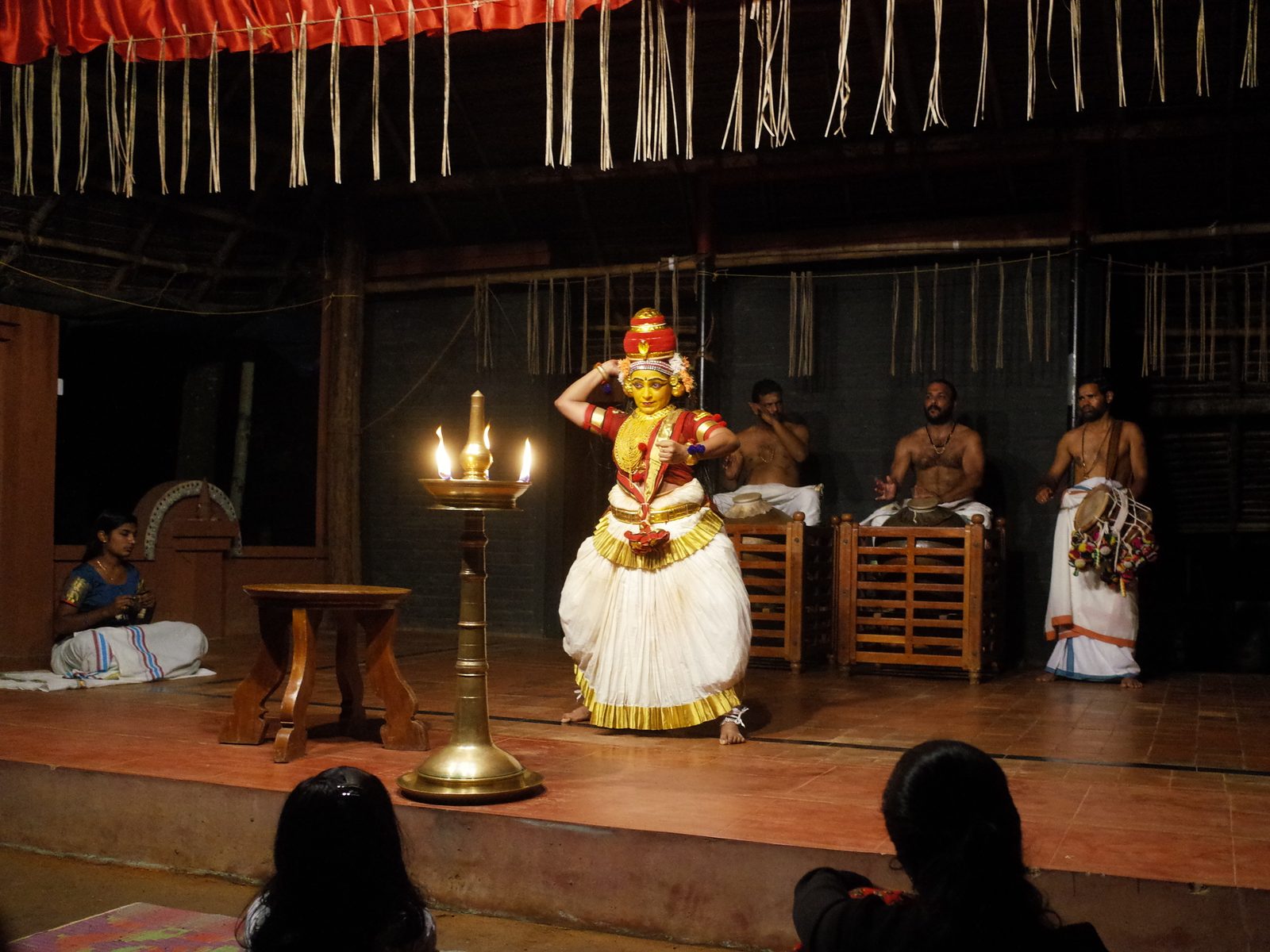
Performance & aesthetics · Sanskrit · Nāṭyaśāstra, Chapter 6
When we weep or laugh in a theatre, whose feeling are we experiencing? It is not quite the actor’s private emotion, nor is it an ordinary grief of our own life.
The sixth chapter of the Nāṭyaśāstra (often spelt Natyashastra), attributed to Bharata Muni, answers that question with one of Indian thought’s most influential sentences, the rasa-sūtra:
विभावानुभावव्यभिचारिसंयोगाद्रसनिष्पत्तिः ।
Read the Sanskrit in Roman letters
vibhāvānubhāvavyabhicārisaṃyogād rasaniṣpattiḥ |
From the combination of determinants (vibhāva), consequents (anubhāva) and transitory states (vyabhicāribhāva), rasa arises. (Bharatiyata’s rendering.)
Why Bharata reaches for the kitchen
To explain this compact rule, the Nāṭyaśāstra turns to food. Just as well-disposed people (sumanasaḥ), eating food prepared with many condiments, taste its flavours and feel pleasure, so well-disposed spectators (prekṣakāḥ) relish the durable emotions (sthāyibhāva). Those emotions are brought out through the enactment (abhinaya) of many states, and carried by speech, the body and sattva: the involuntary signs of inner feeling, such as tears or trembling.
The comparison is precise. None of the ingredients on stage is rasa by itself: not the setting, not a sidelong glance, not a catch in the voice, not a passing tremor of doubt. Rasa is what emerges when a skilled performance meets a prepared spectator.
From private sorrow to common space
Later theorists returned to Bharata’s sentence and argued over how rasa comes about. The critic Bhaṭṭa Nāyaka proposed that poetry and performance generalise an emotion (sādhāraṇīkaraṇa). They lift it out of narrow personal ownership, “this is happening to me” or “that belongs only to someone else”. Abhinavagupta, born in Kashmir in the second half of the tenth century, accepted and developed this idea in his commentary on the Nāṭyaśāstra, the Abhinavabhāratī.
In this account, the attuned spectator, the sahṛdaya (“one with heart”), is freed from practical anxiety. Such a spectator can meet sorrow, courage, wonder or stillness with clear attention. That is one reason a painful scene can be relished rather than simply suffered.
Across Indian dance, music and theatre, the question remains alive: how craft and discipline allow a feeling to cross the distance between one person and another.
A gesture on stage becomes art when an audience can taste its meaning together.
Sources and scope
- Nāṭyaśāstra of Bharatamuni with the Commentary Abhinavabhāratī, vol. I (chapters 1–7), ed. M. Ramakrishna Kavi, Gaekwad’s Oriental Series 36, 2nd ed. (Oriental Institute, Baroda): Sanskrit text of chapter 6 with Abhinavagupta’s commentary. A searchable GRETIL e-text is also available; its source edition is not stated.
- Manomohan Ghosh, trans., The Nāṭyaśāstra Ascribed to Bharata-Muni, vol. I (Royal Asiatic Society of Bengal, 1950), chapter VI, pp. 105–106: the rasa-sūtra and the culinary comparison.
- Raniero Gnoli, The Aesthetic Experience According to Abhinavagupta (IsMEO, Rome, 1956), pp. xx–xxi: Bhaṭṭa Nāyaka’s generalisation and Abhinavagupta’s development of it.
- Sheldon Pollock, A Rasa Reader: Classical Indian Aesthetics (Columbia University Press, 2016; ISBN 978-0-231-17390-2): translated sources from Bhaṭṭa Lollaṭa and Śaṅkuka to Bhaṭṭa Nāyaka and Abhinavagupta.
- Photograph: A Kutiyattam scene performed at Irinjalakuda Thrissur district Kerala.jpg by Tomislav Medak, CC BY-SA 2.0, via Wikimedia Commons; resized for this page and shared under the same licence.

This essay is an editorial orientation based on published editions and translations; it is not expert-reviewed.
Explore more on Kalā: Music, dance & performance, or follow philosophical arguments about mind and perception through Darśana.