
Uttiramerūr Inscriptions: The Kuḍavōlai Village Draw
Chola inscriptions at Uttiramerūr (Uthiramerur), c. 919–921 CE, set rules for choosing village committees by kuḍavōlai: who could stand, who was barred.
Local self-government & epigraphy · Tamil · Two inscriptions of Parāntaka I at Uttiramerūr
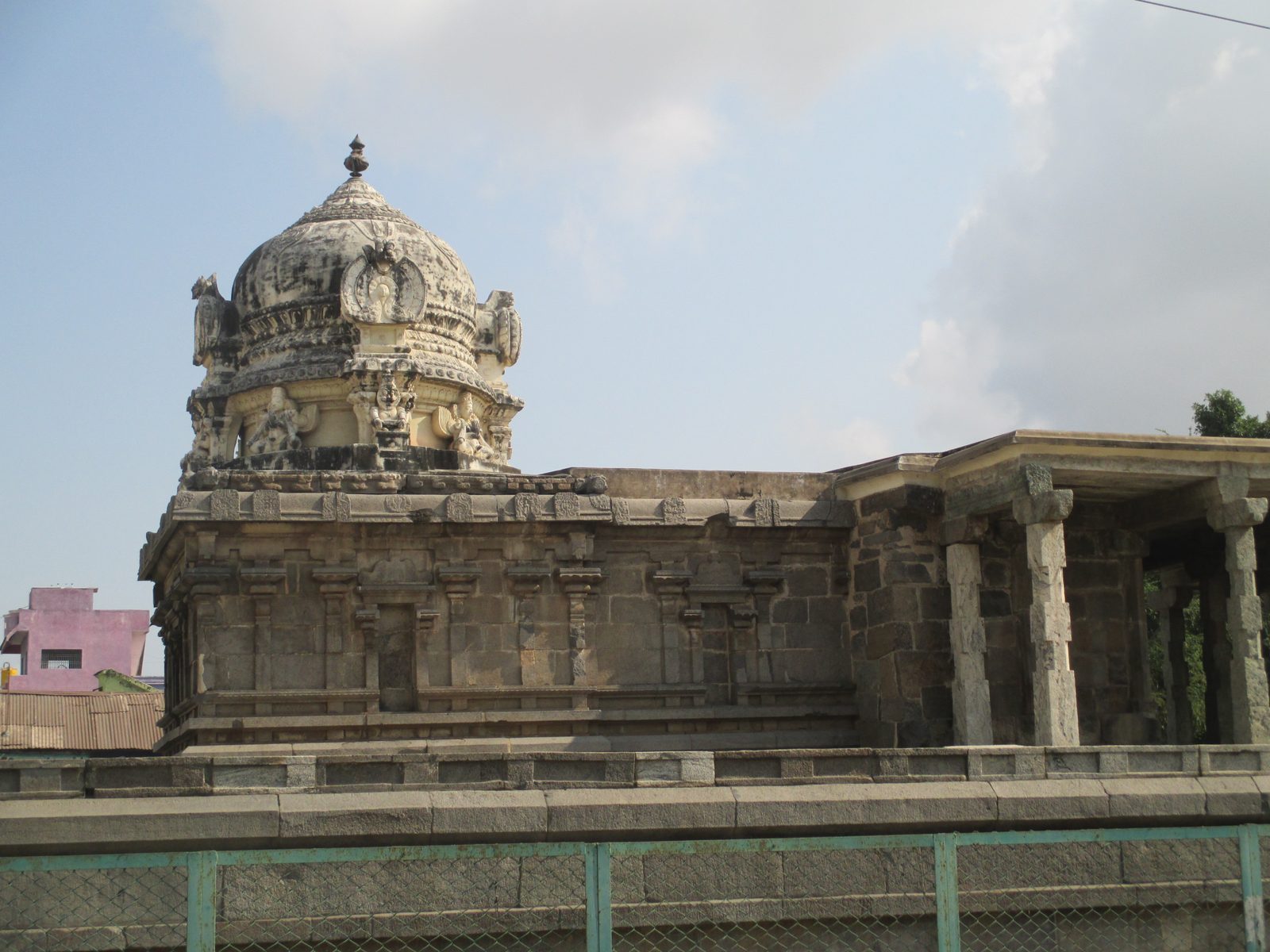
The surviving basement of the Vaikuṇṭha Perumāḷ temple at Uttiramerūr (also spelt Uthiramerur or Uttaramerur), in Kanchipuram district of Tamil Nadu, carries no royal portrait. Its west wall carries something rarer: in long lines of tenth-century Tamil, with Sanskrit words in Grantha letters, the village assembly (sabhā) recorded how it chose its working committees. The record sets out who could be nominated, who was barred, and how a member could be removed.
Two inscriptions there, dated to the twelfth and fourteenth regnal years of the Chola king Parāntaka I (about 919 and 921 CE), set out the procedure. The second does not mention the first, but it changes several of its conditions, including the age limits. V. Venkayya, who edited both in 1904–05, and K. A. Nilakanta Sastri after him read the second as a revision made once the first rules had been tried.
Thirty wards and their committees
The inscriptions call the village Uttaramēru-caturvēdimaṅgalam. A caturvedimaṅgalam was a settlement granted to Brahmin households, and its sabhā governed through standing committees (vāriyam). The second inscription provides for an annual committee (saṃvatsara-vāriyam), a garden committee (tōṭṭa-vāriyam) and a tank committee (ēri-vāriyam). A separate draw filled a gold committee (pon-vāriyam) and a pañcavāra committee. The inscriptions do not spell out every committee’s duties, and scholars read some of them differently.
The second inscription divides the village into thirty wards (kuḍumbu). Residents of each ward met to put forward names for the pot-tickets (kuḍavōlai): palm-leaf slips, each carrying one name.
Who could be nominated
In Venkayya’s translation of the second inscription, a nominee had to:
- own more than a quarter (vēli) of tax-paying land;
- live in a house built on his own site;
- be above thirty-five and below seventy years of age;
- know the Mantra-brāhmaṇa well enough to teach it.
A man with only one-eighth of that land could still be nominated if he had learnt one Veda and one of the four bhāṣyas by expounding them. Among the qualified, the assembly was to choose men conversant with business and of good conduct. A nominee also needed honest earnings and a pure mind, and must not have served on any committee in the previous three years. That rule forced office to rotate between households. The earlier inscription had set the age range at thirty to sixty.
Who was barred
The list of disqualifications is long and specific. A man who had served on a committee and not submitted his accounts could not be nominated. Neither could twelve classes of his relatives, from his father, sons and brothers to his cousins, his wife’s brother, his sister’s husband and his son-in-law. The inscription sets no time limit on this bar.
Others were excluded for their own conduct. These included men recorded as guilty of incest or of the first four of the “five great sins”, men outcast for keeping low company (until they had performed expiation), the “foolhardy”, and anyone who had stolen another person’s property. Some offenders stayed barred for life even after expiation. One such clause uses the word kaiyūṭṭu. Venkayya tentatively translated it as “forbidden dishes”. Some later readers take it to mean a bribe, and its meaning remains uncertain.
The second inscription also provides that a committee member found guilty of an offence is to be removed.
The draw
The draw itself was designed to be seen. Each ward’s eligible tickets were bundled under a covering ticket, and the bundles went into a pot. The full assembly, young and old, was convened. Every temple priest (nambi) in the village that day was seated in the inner hall.
The eldest priest stood and lifted the pot, looking upwards so that everyone could see it. A young boy standing nearby, who did not know what was inside, took out one ward’s bundle. It was moved to a second pot and shaken, and one ticket was drawn and handed to the arbitrator (madhyastha). He received it on his open palm, all five fingers spread, and read the name aloud. All the priests in the hall then read it out as well, and the name was written down. The same was done for each of the thirty wards.
Of the thirty men chosen, those who had served on the garden or tank committees before, and those advanced in learning or age, formed the annual committee. Of the rest, twelve formed the garden committee and six the tank committee. Members held office for 360 days and then retired.
The king’s letter
The second inscription says the rules followed a royal letter from Parāntaka I. They were settled with a royal officer, Karañjai Koṇḍaya-kramavitta-bhaṭṭan, also called Sōmāśiperumān, sitting with the assembly. Historians differ on how far the officer shaped them. Venkayya thought the settlement was probably his work; Nilakanta Sastri saw him as representing the king while the assembly made its own rules.
What the inscriptions show, and their limits
Uttiramerūr is easy to misread in two opposite ways.
One mistake is to treat it as universal-suffrage democracy in miniature. The qualifications of land, a house site and Vedic learning confined candidacy to a narrow group of Brahmin landholders in a caste-stratified agrarian society. Other assemblies existed beside the sabhā: Nilakanta Sastri notes an ūr at Uttiramerūr itself.
The other mistake is to imagine pre-modern Indian government as arbitrary rule without written procedure. The wall records published qualifications, rotation of office, a bar on defaulters and their kin, removal for misconduct, and a lottery among vetted candidates, conducted in public.
A village assembly wrote down who could serve, who could not, and how chance would decide among the rest.
Sources and scope
- V. Venkayya, “Two Inscriptions at Uttaramallur”, Archaeological Survey of India, Annual Report 1904–5 (Calcutta, 1908), pp. 131–145: Tamil text and English translation of both inscriptions. The rules above are paraphrased from this translation.
- K. A. Nilakanta Sastri, Studies in Cōḷa History and Administration (University of Madras, 1932), chapters V–VI: the village, its assemblies and a reading of the Parāntaka inscriptions.
- K. A. Nilakanta Sastri, The Cōḷas, 2nd ed. (University of Madras, 1955), pp. 495–496: dates and summary.
- Photograph: Vaikunta Perumal, Uthiramerur7.JPG by Ssriram mt, CC BY-SA 4.0, via Wikimedia Commons; resized for this page and shared under the same licence.

This is an introductory reading of two published inscriptions, not a new edition. It is not expert-reviewed.
Explore more on Samāja: Society & everyday life, or continue into the Samāja reading journey.